
8th Circuit ends SAVE student loan plan, forcing millions to hunt for new repayment options
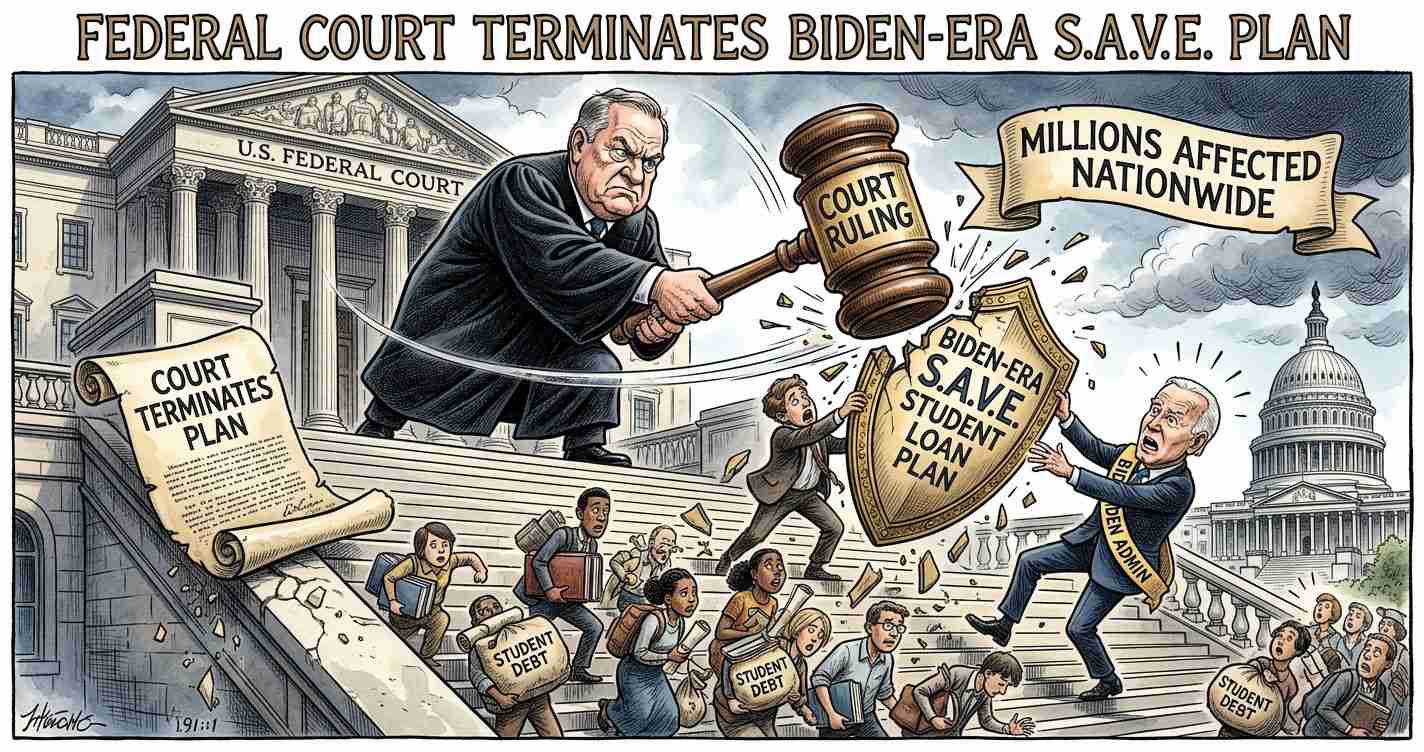
The U.S. Court of Appeals for the 8th Circuit ended the Biden-era SAVE student loan plan on March 9, 2026, halting new enrollments and forcing more than 7 million borrowers to seek alternative repayment options immediately.
Key takeaways
- 8th Circuit SAVE plan ruling on March 9, 2026 reversed a lower-court dismissal and finalized the end of the SAVE program.
- More than 7 million borrowers remain enrolled in SAVE, with roughly 450,000 additional interested or pending applications.
- The decision stops new SAVE enrollments and requires the Department of Education to deny pending applications and transition current enrollees to other plans (TICAS explainer).
- Alternatives include Repayment Assistance Plan (RAP) and Income-Based Repayment (IBR), with differing payment scales and forgiveness terms.
What the court did and why it matters
The 8th U.S. Circuit Court of Appeals reversed a February dismissal by U.S. District Judge John Ross in the Republican-led challenge Missouri v. Trump, effectively ending the SAVE plan as of the March 9, 2026 ruling. The court’s action rescinds many SAVE rules under a proposed settlement tied to the litigation; that settlement still requires final court approval (report, TICAS).
SAVE, launched in 2023 and hailed as the “most affordable repayment plan ever created,” stopped loan balances from growing for many borrowers by covering 100% of unpaid monthly interest and lowering monthly payments. With the plan ended, those protections no longer apply for new enrollments and many current enrollees will be moved to other plans earlier than previously scheduled.
“SAVE prevented loan balances from growing by covering 100% of unpaid monthly interest for many borrowers,” a description that underscores why the program’s reversal matters to repayment progress and forgiveness timelines.
How many people are affected
The Department of Education and advocates estimate more than 7 million active SAVE enrollees, plus about 450,000 borrowers with pending interest or applications. The ruling forces the ED to stop accepting new SAVE signups and deny pending applications, leaving many borrowers uncertain about immediate monthly payment changes and long-term forgiveness credit (TICAS, The College Investor).
What borrowers should know now about repayment options
With SAVE ended, borrowers should review alternatives and act to avoid surprises. Use available tools and counselor help to compare options.
Income-Based Repayment (IBR)
IBR generally sets payments at about 10%–15% of discretionary income, with forgiveness after roughly 20–25 years depending on program details. The One Big Beautiful Bill Act (OBBBA) expanded access to IBR for more borrowers by removing earlier hardship tests (TICAS, TCNJ update).
Repayment Assistance Plan (RAP)
RAP, created under OBBBA and effective July 1, 2026, sets payments on a sliding scale of 1%–10% of Adjusted Gross Income (AGI) with a $10 monthly minimum for very low AGI and forgiveness after 30 years. After July 1, 2026, RAP and the standard plan will be the income-driven options new borrowers can select (TCNJ, TICAS).
Standard, Graduated, Extended
Fixed-payment options (Standard, Graduated, Extended) remain available; these plans are not income-driven and typically run 10–25 years depending on the selected term (TCNJ).
If borrowers take no action, ED transition rules under OBBBA would auto-enroll people into IBR or RAP by July 1, 2028. However, the court order and ED’s proposed settlement accelerate the transition for current SAVE enrollees. Borrowers should use the Federal Student Aid Loan Simulator to compare options and contact their servicer now.
Public Service Loan Forgiveness: verify now
Borrowers pursuing Public Service Loan Forgiveness (PSLF) must act immediately. PSLF cancels remaining debt after 10 years of qualifying public service and payments. Because SAVE paused balance growth for many months, affected borrowers should verify whether those months count toward PSLF and, if they do not, submit forms to reclaim credit. The Department of Education has urged PSLF participants to check eligibility and file paperwork to restore any lost progress (TICAS guidance).
Operational mess and lack of clarity
Advocates and counseling groups say the ED has given limited clarity on timelines, transition mechanics, and whether servicers will credit past SAVE progress toward forgiveness. The proposed settlement rescinds many SAVE regulations, including provisions that aided borrowers in default or simplified applications. Servicers report long backlogs and borrowers report conflicting messages and long waits for help (TICAS).
Legal and political context
The litigation began as a Republican-led challenge seeking to block SAVE. The district court initially dismissed the challenge in February, temporarily preserving access for some borrowers; the 8th Circuit’s March 9 reversal ended the plan. The case illustrates how federal student loan rules can change rapidly when courts and Congress act. OBBBA (2025) had already signaled major repayment-rule changes, including SAVE’s phase-out by July 2028 and RAP’s launch in 2026 (The College Investor, TICAS).
Where to get help
- Use the Federal Student Aid site and the loan simulator to compare repayment plans.
- Review explainers and updates from TICAS.
- Monitor service announcements and guidance such as the TCNJ update on federal loan changes.
- Seek free counseling from non-profit student loan counselors or campus financial aid offices; bring recent statements, income records, and employment history.
Implications for San Luis Obispo, California
Local residents in San Luis Obispo County — including students, public employees, and small-business owners — may feel immediate economic, political, and social effects as monthly payments change and uncertainty grows. Below are local implications and practical steps.
Economic impact
San Luis Obispo County combines public and private workers, students from Cal Poly and Cuesta College, and small-business owners. Higher monthly payments for former SAVE enrollees could tighten household budgets, reducing consumer spending at restaurants, retail shops and services along Higuera Street and downtown SLO. Increased payments may delay home purchases in an already high-cost housing market.
Political consequences
County supervisors, city council members and state representatives may face constituent inquiries and pressure to provide local guidance. Public employees relying on PSLF — county staff, school district employees, Cal Poly personnel and local government workers — should verify records now; HR and payroll offices may be asked to assist with Employment Certification for PSLF.
Social effects
Younger adults and recent graduates are likely to be hit hardest. Increased debt burdens may force tradeoffs on basic needs, delay childcare or medical care, and push some residents toward additional work or gig income. Local non-profits that serve low-income households could see greater demand.
Cultural relevance
Cal Poly and the county value education and community service. Uncertainty over student loan rules, forgiveness credit and repayment structure could erode trust in federal programs among students and public servants, prompting more campus forums, city meetings and local media coverage.
Practical applications for local borrowers
- PSLF-eligible workers: File or refile Employment Certification for PSLF forms and check whether SAVE months were credited (TICAS).
- Compare plans now: Use the Federal Student Aid loan simulator to weigh IBR, RAP (available July 1, 2026) and standard repayment options (TCNJ).
- Seek free counseling: Community colleges, university financial aid offices and local non-profits often offer counseling; bring recent statements, income information and employment records to appointments (TICAS).
For San Luis Obispo residents, acting now matters. With the SAVE plan ended by the 8th Circuit, borrowers should check accounts, verify PSLF credit if applicable, compare repayment options using the loan simulator, and contact servicers or non-profit counselors before auto-enrollment or new deadlines take effect (The College Investor, TICAS, TCNJ).


