Chicago police sources say department told officers not to aid federal agents after Border Patrol shooting, internal dispatch points to patrol chief refusal
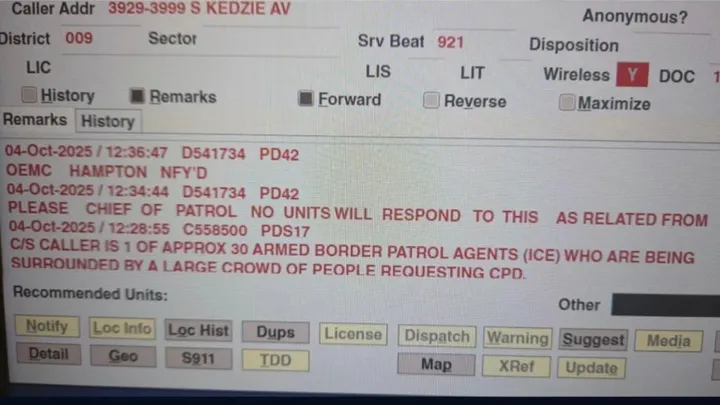
Chicago police sources say officers were instructed not to assist federal agents surrounded by armed protesters after a Border Patrol shooting on the city’s southwest side, raising urgent questions about inter-agency cooperation and public-safety protocols.
Key takeaways
- Officers allegedly instructed not to respond: Internal dispatch records and sources say Chicago police were ordered not to assist federal agents who reported being rammed and surrounded by armed protesters; see the Fox News video report.
- Border Patrol shooting sparked the confrontation: Federal agents say they shot a woman who attempted to run them over and was armed; footage and reporting are available in the video coverage of the incident and protests and TribLive reporting on the Border Patrol shooting in Chicago.
- Debate over mutual aid: The episode has reignited discussion about whether local police should assist federal immigration operations when protests and public-safety risks intersect.
What happened on Chicago’s southwest side
According to federal sources and media reporting, U.S. Border Patrol agents were conducting an enforcement operation early Saturday when agents say a woman in a vehicle attempted to strike them. Agents fired, wounding the woman, who was taken to a hospital and later released, authorities said. Video and reporting documenting the episode are published as video coverage of the incident and protests and in TribLive reporting on the Border Patrol shooting in Chicago.
After the shooting, large crowds gathered near the scene. Federal sources told reporters the scene became volatile: agents reported being rammed by a vehicle and surrounded by protesters, some reportedly armed. On-scene accounts shared with media outlets described the confrontation as dangerous for both federal personnel and bystanders.
Dispatch records and officer reactions
Fox News sources reported that officers listening to dispatch were ordered not to respond to federal agents’ calls for help. The report cites internal dispatch records and quotes sources saying an on-duty patrol chief refused to authorize assistance for federal personnel; see the Fox News video report.
Rank-and-file officers who spoke privately with reporters expressed anger and concern, saying they believed federal agents were in immediate danger and that hesitation to help undermined public and officer safety. These accounts were attributed to unnamed Chicago police personnel in media coverage.
“Mutual aid in rapidly escalating incidents is vital,” said some former law enforcement officials and union representatives who criticized the reported refusal.
Official statements and outside reactions
City and state leaders criticized federal tactics. Illinois Governor J.B. Pritzker described recent federal deployments as a “manufactured performance” and questioned the safety and legitimacy of such operations. Community leaders have demanded investigations, arguing that ICE and Border Patrol actions risk inflaming tensions and harming civilians.
The Department of Homeland Security confirmed the shooting and provided an account consistent with federal sources that agents were threatened and that the woman was treated at a hospital and later released. Media reporting capturing DHS comments and the shooting is available in video coverage of the incident and protests.
Context: protests and federal enforcement
The incident occurred amid broader protests in Chicago and other cities tied to federal immigration enforcement and National Guard deployments. Demonstrations often accompany controversial federal operations, heightening tension between federal agents, local police, and community members. Video and reporting on the broader protests and reactions are collected in the video coverage of the incident and protests.
Inter-agency cooperation debate
The episode reopened an inter-agency cooperation debate. Critics say the alleged refusal exposed federal agents to risk and undermined public safety. Supporters of the patrol chief’s reported decision argue that assisting federal immigration enforcement can damage trust between local police and immigrant communities, potentially making neighborhoods less safe in the long term.
Key question: How should local departments balance immediate protection of officers and civilians with civil-rights concerns, local authority, and community trust? The situation has prompted calls for clarity and review of protocols governing responses to federal requests during volatile operations.
Legal and policy implications
If the internal dispatch and patrol chief’s refusal are verified, the incident could trigger internal reviews of Chicago Police Department protocols for responding to federal requests in volatile situations. Legal experts note local departments are not always required to assist federal agents, but mutual-aid expectations and public-safety protocols often create pressure to cooperate in life-threatening scenarios.
City officials, community groups, and federal agencies are likely to demand transparency as investigators seek to verify the timeline and orders recorded in dispatch logs. Coverage and analysis that helped spark the discussion include reporting from Fox News and TribLive.
Implications for San Luis Obispo, California
Economic impact:
- Local government costs: Potential legal costs, training expenses, and changes to mutual-aid agreements could affect public-safety budgets if similar conflicts arise elsewhere.
- Business confidence and tourism: High-profile clashes can shape perceptions of safety; distant headlines about chaotic law enforcement responses may influence traveler decisions.
Political consequences:
- Local policy debates: County supervisors and city councils may revisit policies on cooperation with federal agencies, sanctuary policies, and memoranda of understanding.
- Election messaging: Candidates may frame public-safety and civil-liberties positions around such incidents.
Social effects & cultural relevance:
- Community trust in policing: Local leaders should monitor how debates over cooperation affect trust between law enforcement and immigrant communities.
- Protest response planning: Organizers and police may reassess plans to reduce escalation and protect bystanders during high-tension events.
Practical applications for residents
- Know local policies: Residents should seek guidance from the San Luis Obispo Police Department and County officials about cooperation protocols with federal immigration agencies.
- Use community channels: Town halls, advisory committees, and community-policing meetings are appropriate places to voice concerns and learn emergency response plans.
- Preparedness: In emergencies, follow official guidance, report threats to local authorities, and avoid confrontations when multiple agencies are present.