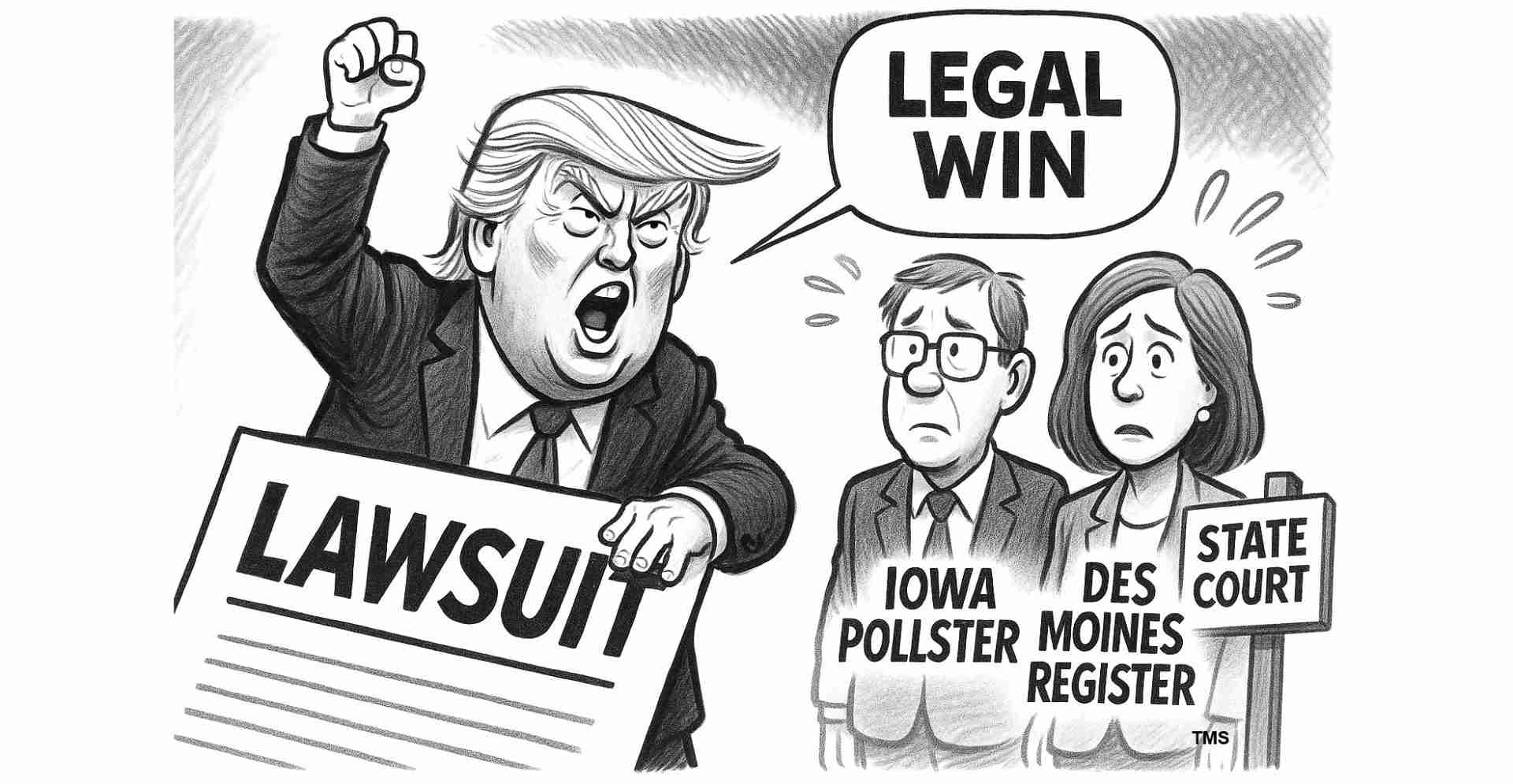
Trump wins procedural victory as Iowa poll lawsuit moved to state court in rare Eighth Circuit order
Donald Trump won a procedural victory when the Eighth Circuit ordered his suit over a controversial Iowa poll returned to state court, overturning a federal judge’s earlier decision and allowing the case to be refiled in Iowa.
- Appellate action: The Eighth Circuit granted a writ of mandamus and remanded the case to state court, reversing a federal judge’s decision.
- Core dispute: The suit alleges a late Iowa poll misled voters by creating a false narrative favoring Kamala Harris and seeks state-law relief.
- Free speech clash: Civil‑liberties groups like Foundation for Individual Rights and Expression (FIRE) call the case a SLAPP-style threat to polling and political speech.
- Practical next step: The federal action was dismissed without prejudice, permitting refiling in Iowa state court.
Background of the lawsuit
The complaint was filed in Polk County, Iowa, in December 2024. It accuses veteran pollster J. Ann Selzer and The Des Moines Register of publishing a final pre-election poll that showed Kamala Harris leading Donald Trump by three points — a result that sharply diverged from the actual outcome, in which Trump won Iowa by more than 13 percentage points. The suit frames the poll as part of a deliberate effort to craft a false “narrative of inevitability” and invokes consumer-protection statutes and other state-law claims.
Court proceedings and the Eighth Circuit ruling
Defendants moved the case to federal court; a federal judge initially refused Trump’s motion to remand. On appeal, the Eighth Circuit granted an extraordinary petition for a writ of mandamus — an uncommon remedy used when a higher court finds clear error by a lower tribunal — and ordered the case sent back to Iowa state court. The appellate court dismissed the federal action without prejudice, allowing the plaintiff to refile in state court. Legal observers stress that the ruling is procedural and did not address the truth or falsity of the underlying allegations.
“The writ of mandamus is rare and highlights the unusual procedural posture; the decision concerns venue, not the merits.”
Allegations of election interference and plaintiff’s claims
Trump’s team alleges the poll’s timing and methodology were designed to mislead voters and media, amounting to election interference. The complaint uses strong language, calling the poll “fake” and arguing it was weaponized to shift public perception at a pivotal moment. Central to the claim is the contrast between the poll’s Harris-ahead result and the final vote tally.
Defendant response and the First Amendment debate
Defendants — including Selzer’s counsel, Bob Corn-Revere, and Gannett (owner of The Des Moines Register) — have described the suit as meritless and emphasized the appellate decision was procedural. They have argued federal courts are the appropriate forum given the constitutional questions and national attention but say they are prepared to litigate in state court if required.
Civil‑liberties groups framed the lawsuit as a First Amendment matter. The Foundation for Individual Rights and Expression (FIRE) announced it would defend Selzer, calling the case a Strategic Lawsuit Against Public Participation (SLAPP) that chills political prediction and expression. FIRE also noted Selzer publicly shared methodological details and demographic breakdowns, which it says undercuts claims of deceptive conduct.
Pollster reputation, media reaction and fallout
J. Ann Selzer was widely regarded as a leading Iowa pollster prior to the controversy. The unexpected divergence between her final poll and the election result intensified scrutiny. In the wake of the backlash, Selzer withdrew from future election polling, citing the fallout and a wish to pursue other projects. Commentators remain divided: some describe the discrepancy as an error within polling margins; others see transparency and professional norms as crucial counters to allegations of malice.
Ongoing legal fight and next steps
With the federal action dismissed without prejudice, the practical next step is refiling in Iowa state court where the original complaint will be litigated. The litigation is expected to raise technical questions about the reach of state consumer-protection laws, whether polling errors can support state-law claims, and how those claims intersect with First Amendment protections. The choice of forum matters because procedural rules and available defenses can differ substantially between state and federal courts.
Implications for San Luis Obispo, California
This high-profile dispute could ripple to local newsrooms and pollsters in San Luis Obispo County and across California. Potential impacts include:
- Economic: Increased legal exposure could raise costs for smaller outlets and pollsters, possibly reducing local polling and investigative reporting.
- Political: Public trust in polls and media could erode; campaigns and voters might change how they treat late-stage surveys.
- Social and cultural: The case may prompt community debates about media responsibility, pollster transparency, and the balance between accountability and free speech.
- Practical: Local civic groups may host explainers and forums on poll methodology to bolster media literacy and voter confidence.
Sources and further reading
Key reporting and analysis on this matter include:
- Fox News: “Trump scores legal win; he gets lawsuit against Iowa pollster, Des Moines Register moved to state court”
- Foundation for Individual Rights and Expression (FIRE): “FIRE to defend veteran pollster J. Ann Selzer in Trump lawsuit over outlier election poll”
- Des Moines Register reporting on the filing and timing of the suit
Note: The appellate ruling is procedural and does not resolve the merits. The case will now proceed in Iowa state court, where the central questions about polling, consumer-protection law, and First Amendment limits will be litigated in detail.