Trump bars underperforming defense firms from buybacks and dividends, ties executive pay to production performance
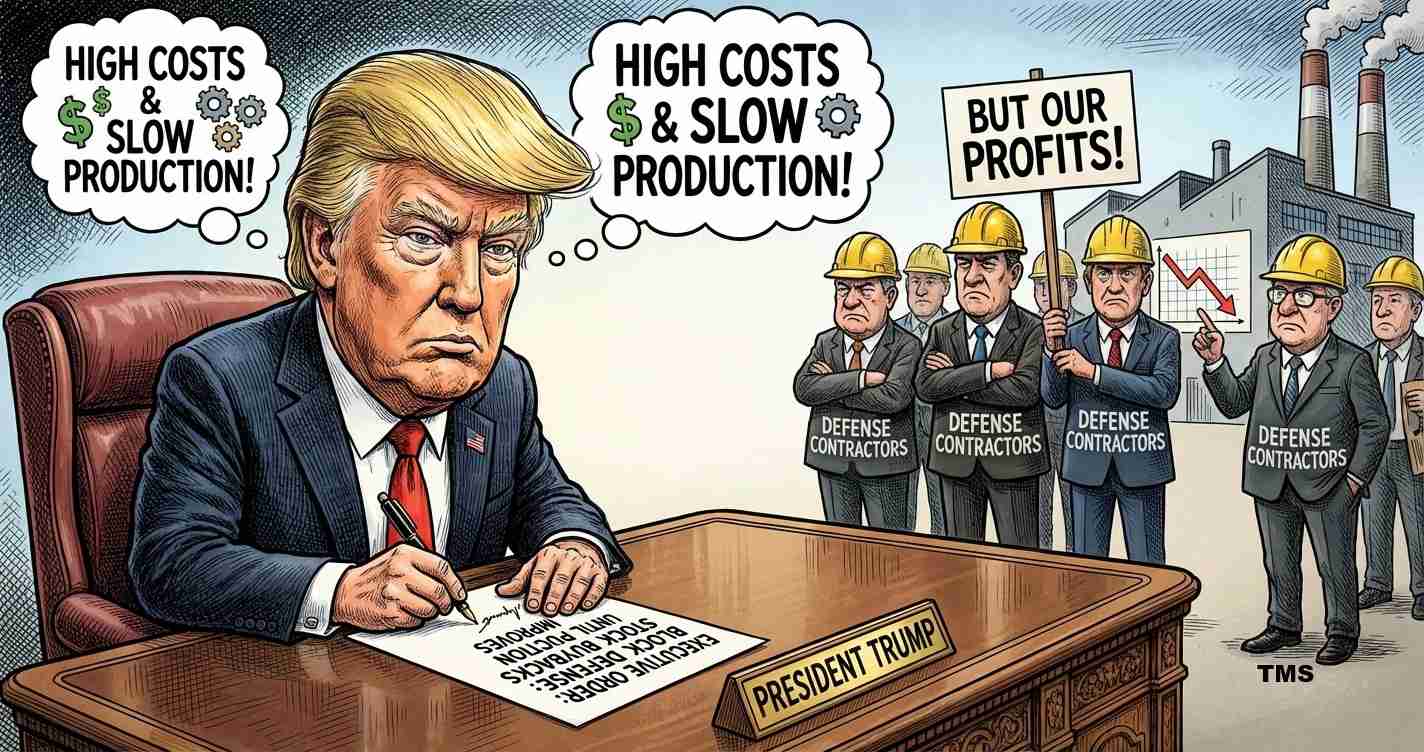
President Donald Trump signed an executive order that bars underperforming U.S. defense contractors from stock buybacks and dividends and ties executive compensation to weapons production and on‑time delivery, aiming to prioritize readiness over shareholder returns.
- The order blocks dividends and buybacks for firms judged underperforming until they improve production and on‑time delivery — see the White House fact sheet.
- Pentagon timelines: Defense Secretary Pete Hegseth has 30 days to identify underperformers; firms get 15 days to submit remediation plans (Fox Business).
- Contract clauses and pay rules: New and renewed contracts will block buybacks/dividends during remediation and tie executive pay to production metrics (Breaking Defense).
The mechanics of the executive order
The order lays out a three-step enforcement process designed to steer capital toward production and on‑time delivery.
Step 1: The Department of Defense will flag contractors that are falling short on delivery, not investing enough in capacity, or prioritizing shareholder returns over government work. The Pentagon has 30 days to create that list — see the White House fact sheet.
Step 2: Companies deemed underperforming will be notified and given 15 days to submit a remediation plan. If a plan is inadequate, firms will be barred from paying dividends or buying back stock while labeled underperforming (Fox Business).
Step 3: Within roughly 60 days, future contracts will include language blocking buybacks and dividends during remediation and require executive incentives to tie to on‑time delivery and increased production rather than short‑term financial metrics (Breaking Defense).
Prioritizing the warfighter over shareholders
The White House framed the move as correcting what it calls “misplaced priorities” at legacy defense firms. Officials argue some companies favored dividends and buybacks to lift share prices instead of investing in plants, equipment and on‑time delivery for the military (White House fact sheet; Breaking Defense).
Trump has publicly criticized capital returned to shareholders and suggested temporary limits on CEO pay — he has floated an informal cap near $5 million for top executives until production problems are fixed — though the order focuses on contract terms rather than an absolute pay cap (Politico; Breaking Defense).
Big primes named and industry context
Multiple outlets point to major defense primes including Lockheed Martin, RTX (Raytheon), Northrop Grumman and General Dynamics. Politico noted those four paid roughly $89 billion in dividends and buybacks from 2021–2024, drawing administration scrutiny.
Trump singled out RTX/Raytheon by name in public remarks about buybacks and future access to U.S. government business; some coverage criticized that firm’s responsiveness to Pentagon needs (Breaking Defense; White House fact sheet).
Stocks dip on the news
The announcement sent defense stocks lower during New York trading. Multiple outlets reported sector declines with firms such as Northrop noted down roughly 4% on the day; coverage described the sector broadly “in the red,” though exact intraday percentages vary across reports (Politico; Breaking Defense).
Legal, financial and practical questions
Corporate lawyers note the White House cannot directly set executive pay or corporate capital policy for private firms; instead, the order uses government contracting power as leverage by attaching conditions to military contracts. Experts expect legal challenges if firms contest the contract terms (Politico).
Market analysts and defense specialists question how quickly capacity can be expanded: contractors generally will not build plants or hire at scale without steady, long‑term demand signals such as multi‑year contracts or predictable orders. The Pentagon has tried to spur capacity with longer deals; for example, Lockheed has been expanding Patriot missile output under multi‑year arrangements. Critics say limiting buybacks alone may not fix deeper supply‑chain and workforce bottlenecks (Defense One; Politico).
Why buybacks matter here
Stock buybacks occur when a company uses cash to repurchase its own shares — a move that can lift earnings per share and reward investors but may divert money from factories and hiring. From 2021–2024 the big primes returned tens of billions to shareholders through buybacks and dividends, a fact the administration cites in arguing for a rebalancing toward production and readiness (Politico).
What to expect in the coming weeks
- Within 30 days: the Pentagon identifies underperforming contractors (White House fact sheet).
- Within 15 days after notification: firms must submit remediation plans (Fox Business).
- Within about 60 days: contract language changes for new and renewed deals; executive compensation shifts toward production metrics (Breaking Defense).
What is and isn’t confirmed
The policy and timeline appear in the White House fact sheet and in reporting across outlets. Trump’s naming of RTX/Raytheon and criticism of the sector are documented, but some specific phrasings and exact intraday stock percentages cited in summaries do not appear verbatim in the major articles and the fact sheet reviewed (Breaking Defense; Politico).
Local impact on San Luis Obispo, California
Economic impact: San Luis Obispo County and the Central Coast host defense suppliers, engineering firms and veterans working in aerospace and defense. If primes redirect capital from dividends to factories, local suppliers could see increased demand for components, testing and maintenance—potentially boosting jobs for small and mid‑sized firms. Short‑term market turmoil could also constrain investment and slow hiring until contract terms and financing are clearer (Politico).
Political and budget consequences: Local officials who favor defense jobs may press Washington for clear multi‑year contracts to give Central Coast suppliers predictable work; the policy will likely surface in local debates about federal policy and jobs (White House fact sheet).
Social effects: Workers at plants and small shops may face short swings in workload as primes respond to new contract rules. Veterans and military families in the area are watching changes billed as improving readiness and equipment delivery (Defense One).
Practical applications: Local suppliers and workforce programs should watch the Pentagon’s 30‑ and 60‑day timelines and be ready to bid on expanded work; economic development offices can help match businesses to subcontracting opportunities and federal contracting assistance (White House fact sheet).
Reporting and documents reviewed
- White House fact sheet: “President Donald J. Trump Prioritizes the Warfighter in Defense Contracting”
- Breaking Defense coverage of the order and comments to CEOs
- Fox Business reporting on the executive order, timelines and remediation plans
- Defense One analysis of industry reaction and production concerns
- Politico reporting on buybacks, dividends and the $89 billion figure for major primes
Reporting adapted for Times Media Service from the public fact sheet and the reporting cited above.
“The goal, according to the White House, is to prioritize the warfighter by rewarding production performance and investments that build capacity.”