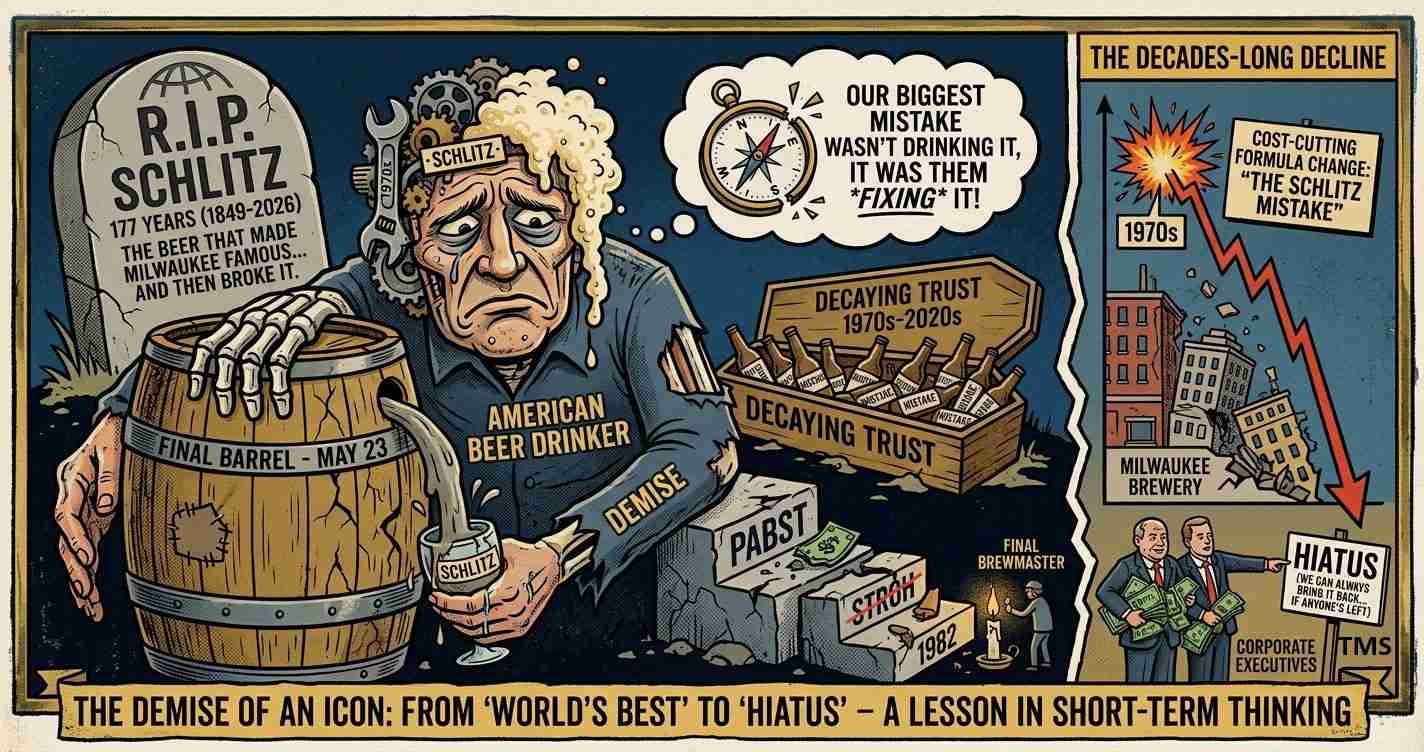
Schlitz beer retirement: Iconic Milwaukee lager brews final batch after 177 years
After 177 years, Schlitz beer brewed its final batch on May 23 at the Wisconsin Brewing Company in Verona. Pabst retired the brand due to rising storage and shipping costs that made the low‑volume label unsustainable.
Key takeaways
- Final brew: The last official Schlitz batch was brewed May 23 in Verona by brewmaster Kirby Nelson at the Wisconsin Brewing Company.
- Reason for retirement: Pabst says rising storage and shipping costs for lower‑volume labels made continuing Schlitz impractical (comments reported to Milwaukee Magazine).
- Legacy: Schlitz traces to 1849 and rose nationally after supplying Chicago after the Great Chicago Fire, later becoming a cautionary tale after mid‑century cost‑cutting changed its reputation (see Encyclopedia of Milwaukee).
A brief history: Milwaukee brewing history that made a national brand
Origins: Schlitz began when Joseph Schlitz took over August Krug’s brewery, forming the Joseph Schlitz Brewing Company in 1849. Milwaukee’s wave of German immigrant brewers — including Pabst, Blatz and Miller — turned the city into a national beer center.
Growth: Schlitz expanded rapidly; after the Great Chicago Fire of 1871 the company moved quickly to supply Chicago while local rivals rebuilt, a strategic push historians credit with propelling Schlitz into a national market (Encyclopedia of Milwaukee).
The peak and the mistake
Mid‑century prominence: Through the 1940s and 1950s Schlitz ranked among America’s best‑selling beers — heavy advertising and wide distribution made slogans like “the beer that made Milwaukee famous” widely known.
“The Schlitz mistake”: In the 1960s–70s management sought faster production and lower costs by altering the brewing process and ingredients. Those changes — intended for quicker clarification and expense reduction — noticeably altered taste and quality, a turning point many beer historians cite (coverage and commentary aggregated in trade writing such as AmericanCraftBeer.com).
Ownership changes and a quiet decline
After market share eroded, Schlitz passed through multiple owners. Pabst acquired the brand in 1999 and positioned it as part of a portfolio of legacy beers. In recent decades Schlitz existed largely as a heritage or nostalgia brand, available in select markets and remembered by collectors and older drinkers. The original brewery site in Milwaukee was redeveloped into Schlitz Park, preserving elements of the industrial legacy.
Why Pabst is retiring Schlitz now
Business rationale: Pabst’s head of brand strategy, Zac Nadile, told Milwaukee Magazine that increasing costs to store and ship lower‑volume products made continuing labels like Schlitz untenable. The brand no longer moved the sales needle enough to justify inventory and logistics expenses.
Decision framing: Company sources describe the retirement as final rather than a temporary pause or regional relaunch; the May 23 brew is the official last batch produced under the Schlitz label.
The final brew and what to expect
The last batch — brewed by Wisconsin brewmaster Kirby Nelson — is primarily symbolic, not a mass‑market push. Local interest in Verona and Milwaukee is high among collectors and longtime fans; bottles and cans from the final run are likely to become sought‑after collectibles by beer memorabilia enthusiasts.
Public reaction: nostalgia, derision and memories
Online reaction mixes sadness and fond memories with scorn from critics who blame the brand’s decline on past quality declines. Social posts aggregated on platforms like X and coverage in national outlets reflect a mixed cultural memory — equal parts affection and critique (see broader coverage such as The Independent).
“Original formula was decent. Then it became swill,” reads a common refrain — illustrating how a brand’s change in perceived quality can shape its legacy.
Legacy: lessons from a brand that once helped make Milwaukee famous
Schlitz’s arc offers several takeaways: a business caution about short‑term cost cutting that harms long‑term reputation; a chapter in Milwaukee’s industrial identity; and an example of broader shifts in American beer — consolidation, the rise of craft brewing, and changing consumer tastes.
Implications for San Luis Obispo, California
Economic impact: Direct local effects are small — Schlitz has not been a major seller in San Luis Obispo County for years. Indirectly, collectors, vintage‑label buyers and beer festivals may see increased demand and prices for final‑run Schlitz merchandise.
Political and regulatory note: Minimal direct political consequence locally, but the story underscores supply‑chain and logistics pressures that also affect small California producers and may inform local economic development and business planning.
Social and cultural effects: Nostalgia among older residents, interest from craft brewers and beer historians, and opportunities for local programming — tastings, retrospectives or memorabilia events — are likely.
Practical applications for residents
- Watch local marketplaces and thrift shops for final‑batch cans and bottles that may surface and increase in value.
- Local breweries and bars can host retrospectives comparing mid‑century lagers to modern craft beers to attract visitors and educate patrons.
- Small producers should note the logistical reasons cited by Pabst when planning storage, shipping and inventory strategies.
Sources and reporting
This article draws on historical and contemporary reporting, including the Encyclopedia of Milwaukee’s entry on the Joseph Schlitz Brewing Company (Encyclopedia of Milwaukee), recent reporting in Milwaukee Magazine quoting Pabst’s Zac Nadile, national coverage such as The Independent, trade and beer‑writing reflections (for example AmericanCraftBeer.com), official brand information from Pabst Brewing Company and details about the final brew from the Wisconsin Brewing Company.