AI fuels a blue-collar productivity boom, or threatens jobs? Palantir CTO Shyam Sankar and Sen. Bernie Sanders clash over data centers and the future of work
A sharp debate unfolded in Washington as Palantir CTO Shyam Sankar hailed AI for sparking a “blue-collar productivity boom” in manufacturing, while Senator Bernie Sanders warned AI and data centers threaten jobs and community resources.
- Palantir CTO Shyam Sankar says AI is creating more jobs and higher productivity in manufacturing, not mass unemployment (moomoo; Fox Business).
- Sankar points to examples where AI enabled new shifts and sped up worker training, arguing the U.S. should focus on applying AI to the real economy (moomoo; Sankar essay).
- Senator Bernie Sanders warns AI and robotics could eliminate millions of jobs and is pressing for a moratorium on new data centers (moomoo; Fox Business).
- The debate raises a core policy question: balance hyperscale infrastructure against worker protections and steer AI investment toward factories and frontline services (Sankar essay).
SHYAM SANKAR: AI AS A BLUE-COLLAR PRODUCTIVITY BOOST
Shyam Sankar, Palantir’s chief technology officer, argues AI can lift productivity for frontline workers — not only for programmers and managers. He says AI tools can turn complex data into simple guidance for workers on the shop floor, in hospitals, and in logistics, calling this a “blue-collar productivity boom.” (moomoo; Sankar essay).
Concrete examples: Sankar described a U.S. manufacturing customer where AI improved production planning enough to add a third shift — the plant ran more efficiently, hiring another shift became profitable, and that translated into additional jobs. He also cited a Panasonic Energy battery plant where AI-driven systems reportedly shortened technician training from about three years to roughly three months for some workers, opening high-wage factory roles to previously inexperienced hires (moomoo).
Sankar warns the nation has emphasized the “supply side” of AI — big models and large data centers — without enough focus on the “demand side”: how to deploy AI so it creates economic value and broad-based prosperity. In his essay he cautions that technology alone can add complexity and bureaucracy; real gains occur when AI changes how work gets done (Technology is the problem).
BERNIE SANDERS: A MORATORIUM TO GIVE DEMOCRACY TIME TO CATCH UP
Senator Bernie Sanders presents a contrasting view: how will people survive if AI and robotics eliminate millions of jobs? Sanders and allied progressives argue unchecked AI deployment could concentrate wealth with tech firms while hollowing out job quality for many Americans (moomoo; Fox Business).
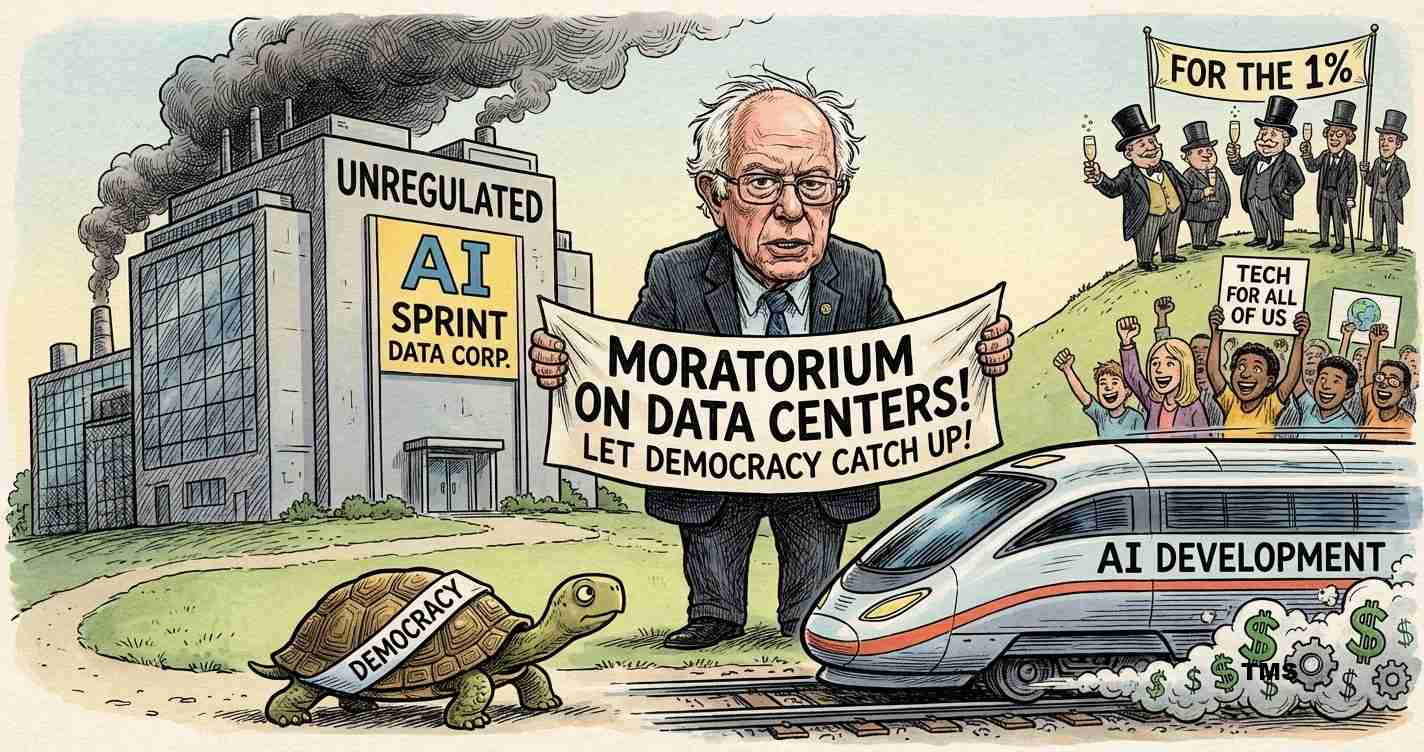
To slow the pace, Sanders is pushing for a moratorium on construction of new data centers that power AI models. He argues a pause would give lawmakers time to create rules protecting workers and communities and to ensure AI benefits are widely shared rather than captured by “the 1%.” The proposal also highlights local impacts of hyperscale centers — energy and water use, land use, and tax incentives — which critics say often produce limited community benefits (moomoo).
SUPPLY-SIDE VS. DEMAND-SIDE: A CORE DISAGREEMENT
Both sides agree AI is transforming the economy but disagree on pace and direction. Sankar says the U.S. has overbuilt data-center capacity and model infrastructure without enough focus on deploying AI where it raises wages and creates jobs. His remedy: redirect investment toward real-world applications in manufacturing, health care, and logistics (Sankar essay; short video).
By contrast, Sanders wants to slow or pause construction while rules are written. His moratorium idea aims to give regulators time to set guardrails: worker protections, tax or redistribution measures, and community safeguards around siting and resource use (moomoo).
THE BROADER CONTEXT: MANUFACTURING, WORK, AND DATA CENTERS
The debate reflects wider policy choices. Many U.S. officials want to reshore manufacturing — batteries, semiconductors and electric vehicles — and firms argue AI can make domestic manufacturing competitive by improving maintenance, quality control, and scheduling. Sankar’s examples support that argument (Sankar essay).
Simultaneously, growth of hyperscale data centers raises concerns about large electricity and water consumption and the value of tax incentives. That has led local officials, environmental groups, and lawmakers to scrutinize or seek moratoria on such developments (moomoo).
COMPETING NARRATIVES: JOB CREATION VS. JOB LOSS
- Sankar’s narrative: AI is a productivity lever that can expand capacity, create shifts, speed training, and raise pay for frontline workers when implemented with care — investment should shift from building models to deploying them where they touch ordinary workers (moomoo; Sankar essay).
- Sanders’ narrative: Without rules, AI could displace millions, deepen inequality, and strain host communities; a moratorium would pause expansion while lawmakers design protections (moomoo).
IMPLICATIONS FOR SAN LUIS OBISPO, CALIFORNIA
Economic impact
San Luis Obispo County mixes light manufacturing, agriculture, tourism and growing tech/logistics sectors. If AI deployments prioritize the demand side, local manufacturers and food processors could use AI tools to boost efficiency and create jobs requiring new technical skills, supporting higher wages and stable shifts for frontline workers.
A data center moratorium could slow proposals for large server farms, limiting short-term construction jobs and potential tax revenue but protecting agricultural water supplies and avoiding spikes in local energy demand tied to hyperscale centers.
Political consequences
Local leaders will face trade-offs. Business and workforce groups may favor targeted AI deployment and reskilling programs to capture productivity gains, while environmental and community advocates may back tighter rules or moratoria to guard resources and ensure local benefits. The debate could shape county planning, zoning, and community-benefit requirements.
Social effects
Workers in manufacturing and tourism may see shifts in job tasks and training needs. If companies follow Sankar’s model, accelerated on-the-job training could open new, higher-paying roles. If automation replaces tasks without retraining, some workers may face job loss or displacement without stronger safety nets.
Cultural relevance
San Luis Obispo values its small-town character, outdoor spaces and agricultural heritage. Data-center developments that change land use or strain water resources may meet public resistance, while local pride in skilled trades could make residents receptive to AI that supports well-paid, stable blue-collar work.
Practical applications
Policymakers should weigh incentives for AI deployments that include workforce training, local hiring commitments, water and energy safeguards, and clear tax benefits. Workforce boards and community colleges can partner with employers to design short apprenticeships and reskilling programs modeled on training examples Sankar cites. If a moratorium is considered, leaders could use the pause to craft strict siting rules and community-benefit conditions rather than an outright ban.
SOURCES AND FURTHER READING
- “AI revolution, mass unemployment? Palantir CTO: AI is driving a blue-collar productivity boom,” moomoo — reporting on Sankar and Sanders remarks.
- Fox Business — video with discussion of the exchange.
- Shyam Sankar, “Technology is the problem” — essay and public writing on implementation and productivity.
- Sankar on applying AI to industrial weaknesses (short video).