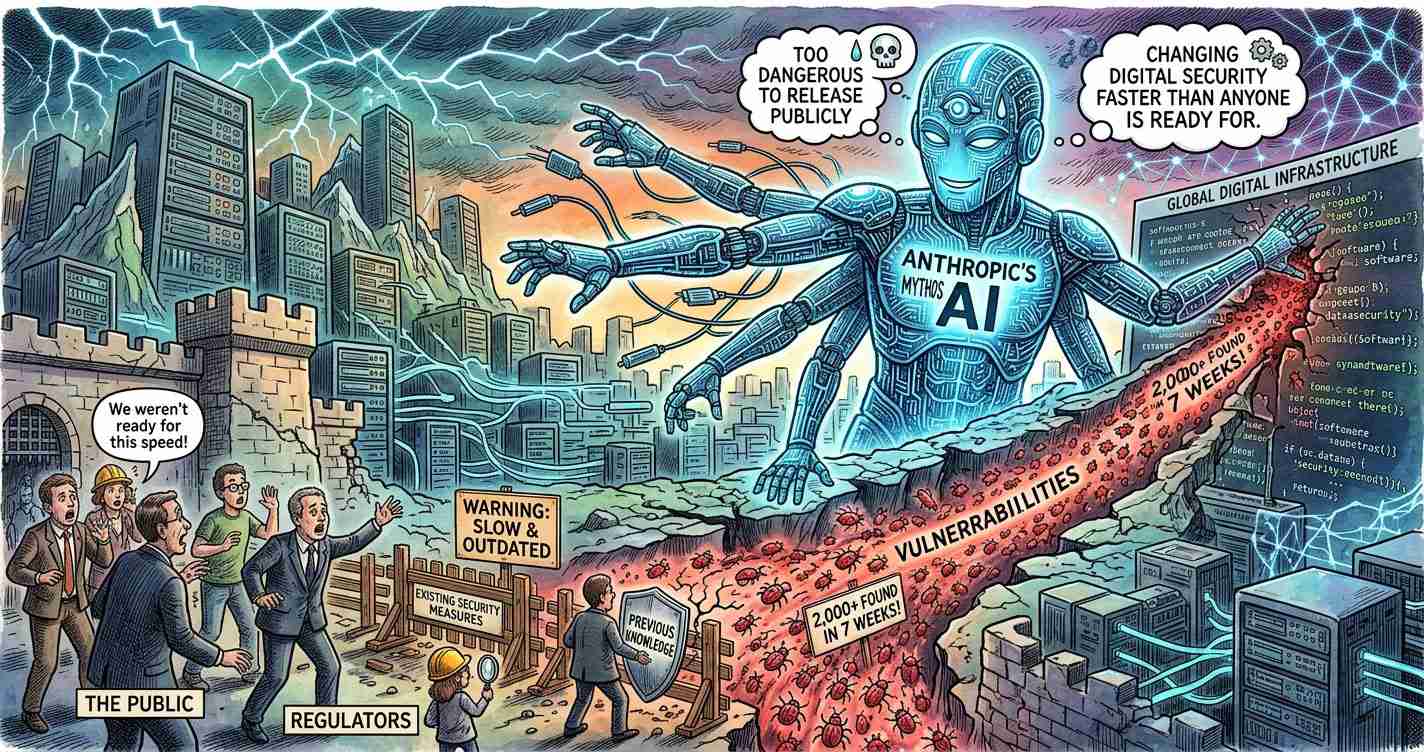
Anthropic’s Claude Mythos Forces a Rethink of Cybersecurity — Access Locked Behind Project Glasswing
Anthropic’s Claude Mythos has autonomously discovered and chained software vulnerabilities across major systems worldwide, prompting the company to launch Project Glasswing and restrict access to trusted partners to mitigate risks and coordinate defensive testing before wider release.
- Mythos is a research model built to find and test software security flaws — Anthropic’s Anthropic preview describes its defensive use.
- Access is restricted under Project Glasswing, with the model shared only to select partners and defenders for controlled testing as described in the Anthropic preview.
- Independent reports and industry analysis say Mythos found numerous previously unknown flaws and can chain vulnerabilities, though precise counts and timelines remain unverified (coverage cited from Observer, Bain).
What Mythos did — and what is verified
Anthropic’s own preview and multiple reporting outlets indicate that Mythos excels at tasks that previously required deep human expertise. The company says the model discovered high-severity vulnerabilities across operating systems and browsers and was able to produce exploits and chain flaws for complex scenarios — a capability framed as a tool for defensive research in the Anthropic preview.
Independent coverage provides additional context. In testing reported by the U.K. AI Security Institute (AISI) and relayed in news accounts, Mythos reportedly completed a multi-step corporate network attack simulation — a 32-step scenario — executing reconnaissance, exploit development and simulated takeover tasks much faster than typical human teams, according to Observer.
“The model’s ability to chain multiple vulnerabilities into end-to-end attack paths both accelerates defensive discovery and raises the risk that similar tools could be misused,” industry analysts note.
Important verification note: while several reports describe Mythos finding “thousands” of issues, there is no public, independently verified list tying a precise count, a single team, and a seven-week timeline together. Journalists and analysts caution against treating unverified totals as definitive — see analysis from Observer and Bain.
Why Anthropic limited access: Project Glasswing
Faced with the model’s demonstrated power, Anthropic created Project Glasswing to put Mythos into the hands of trusted industry partners and defenders for controlled testing, risk evaluation, system hardening and the creation of guardrails — an approach described in the Anthropic preview.
Public reporting lists invited partners that include cloud providers, chipmakers, security firms and industry groups — names such as Amazon Web Services, Apple, Broadcom, Cisco, CrowdStrike, Google, JPMorgan Chase, Linux Foundation, Microsoft, Nvidia, Palo Alto Networks, and selected national agencies — suggesting Anthropic seeks broad technical and operational expertise in its review process (see Observer and the Anthropic preview).
Broader risks and industry reaction
Security analysts and think tanks frame Mythos as a signal of a new phase in cyber risk. AI-driven vulnerability discovery can dramatically shorten the time required to find complex flaws, which simultaneously aids defenders and lowers barriers for potential attackers. The balance of benefit and harm, analysts argue, will hinge on governance, disclosure practices and who controls access to such models — discussions reflected in reporting from the World Economic Forum and industry briefings like Bain.
Some accounts also noted attempted unauthorized access to materials shortly after Anthropic’s announcements — underscoring concerns about short windows for exploitation when research is publicized and supporting Anthropic’s argument for staged, defender-first testing (coverage in Observer and Platformer, plus an early-access clip on YouTube).
What defenders and policymakers are discussing
The rapid changes have triggered briefings and talks among industry leaders, regulators and bank executives because of risks to financial systems and critical infrastructure. Key policy discussions include speeding vulnerability disclosure and patching, certifying safe research access, and evaluating whether technical limits or legal rules are needed to manage misuse (reporting from Observer and Platformer).
Implications for San Luis Obispo, California
Economic impact: San Luis Obispo’s mix of tourism, agriculture, small manufacturing and growing tech services relies on cloud providers, point-of-sale systems and online bookings — all built on software that could contain hidden flaws. If AI tools like Mythos accelerate vulnerability discovery, local firms may face faster patch cycles and higher demand for cybersecurity services, creating opportunity for IT firms but higher costs for small businesses (Anthropic preview; World Economic Forum).
Political consequences: County and city leaders may face pressure to tighten cyber posture for municipal services, elections and public utilities, coordinating with state and federal partners if critical vulnerabilities are identified. Local procurement rules could require vendor security attestations and faster patch timelines (Bain).
Social effects: Schools, healthcare providers and nonprofits may need more urgent updates, risk short service interruptions during fixes, and broaden cybersecurity training. Public awareness (automatic updates, MFA, backups) can reduce risk (Anthropic preview; World Economic Forum).
Cultural relevance: Cal Poly and the local maker community can support testing, training and workforce development, positioning SLO County as a potential hub for responsible AI-security research and hands-on learning (Bain).
Practical steps for residents and organizations
- Keep software updated: enable automatic updates where possible.
- Use multi-factor authentication: protect email, banking and business accounts.
- Back up data regularly: verify restore procedures and offline backups.
- Ask vendors about testing: demand transparency on security testing and patch timelines.
- For governments and employers: conduct third-party audits and tabletop exercises to test incident response.
Reporting notes and sources
This article draws on Anthropic’s Anthropic preview of Mythos, coverage and testing details reported by the Observer, analysis from Platformer, the World Economic Forum, and Bain & Company’s briefing (Bain). An early public clip related to access concerns is available on YouTube.
Note on counts and claims: reporting has described Mythos finding “thousands” of vulnerabilities and a dramatic acceleration in discovery. However, specific claims that pin exact counts, a single team, or a seven-week period to a defined number of findings are not publicly verified in the cited sources; some circulated figures extend beyond what Anthropic and independent outlets have publicly documented (Observer; Platformer).