
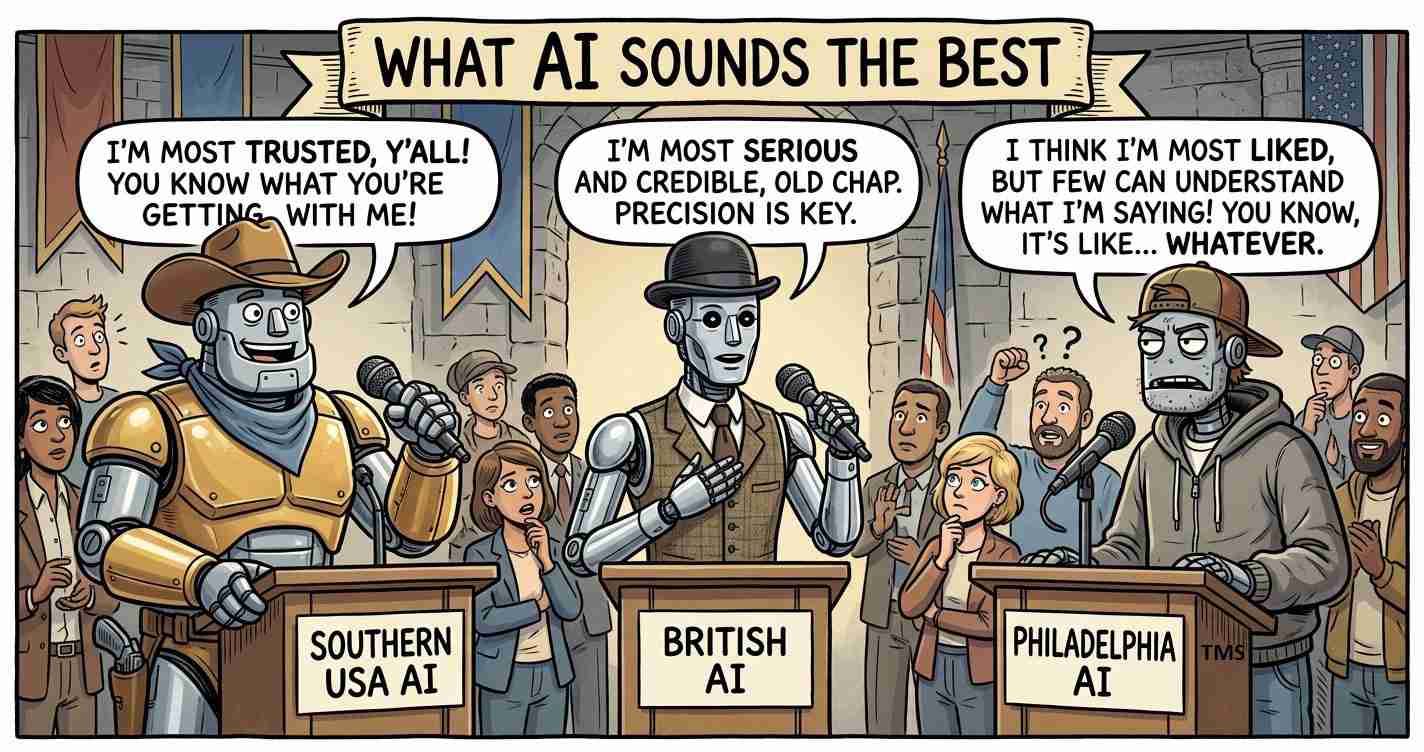
People prefer warm, human-sounding AI — and the Southern accent wins
A survey of 3,023 users finds people prefer AI voices with human character and regional warmth over bland robotic tones, with the Southern accent favored for its gentle, reassuring quality that builds trust and approachability in technology.
Key takeaways
- Sample: 3,023 respondents surveyed by The Word Finder.
- Main finding: Users favor human-like AI voices with regional warmth over neutral robotic speech; 75% prefer human-sounding voices.
- Top pick: Southern accent — described as gentle, reassuring, and resonant with “calm authority.”
- Preferences: 73% want one consistent accent; only 2% want their own voice cloned (study).
Main content
Key information
Sample: The survey polled 3,023 users to gauge preferences around AI speech. The data show strong preference for voices that convey warmth, personality and regional identity rather than sterile neutrality.
Why voice matters
People don’t just want facts from their devices; they want a personality they can trust. Respondents reacted most positively to voices that felt approachable — sometimes even a little theatrical. Think Matthew McConaughey-style gentle coaching or a friendly librarian voice recommending books.
“Voice is how technology builds emotional connection,” the survey notes — users favored tones that felt human, consistent and contextually appropriate.
Notably, the Southern accent AI voice topped responses for sounding both warm and authoritative, combining reassurance with credibility.
Top accents and what they convey
- Southern (No. 1): Gentle, reassuring, “calm authority” — comforting without being paternalistic.
- New York City: Confidence and efficiency — brisk, direct, gets you where you need to go.
- BBC English: Trust and intelligence — the international “expert” timbre many associate with credibility.
- New England: Realism and blunt charm — straightforward, a little sardonic.
- SoCal/Valley: Relaxed friendliness — casual, sunny, and easy-going.
- Texas drawl: Storytelling confidence — larger-than-life narratives delivered with swagger.
Regional flavors that stuck around
Respondents also highlighted accents from New Jersey, Philadelphia, Chicago and Louisiana as adding distinct personalities to AI. Each brings recognizable regional traits — from gritty tenacity to bayou soul — that make AI voices feel local and relatable.
Follow-up findings: trust, smarts and context
Follow-up questions revealed nuance: while Southern accents scored highest for trust and were nearly tied with British accents for sounding the smartest, context mattered. For high-stakes topics like finance, respondents favored Midwestern or neutral American accents for perceived trustworthiness.
Expert perspective
Praveen Latchamsetty, founder of The Word Finder, told researchers that voice is more than a feature — it’s how technology builds emotional connection. The data back that up: large majorities favor consistent, human-like, regionally adapted AI voices rather than sterile neutrality.
Implications for San Luis Obispo, California
- Economic: Local businesses offering voice-driven services (tourism apps, hospitality chatbots, retail kiosks) could gain an edge by adopting warm, regionally tuned AI voices — e.g., a SoCal-leaning voice blending relaxed friendliness with clear guidance.
- Political/policy: City and county communications that use voice tech (emergency alerts, public service messages) should test voices for trust and clarity; the study suggests a neutral Midwestern-style voice may perform best for serious, technical notices (research).
- Social/cultural: In a coastal community mixing tourists and long-time locals, using regionally resonant voices can make technology feel less alien and more community-minded — without erasing professional tone (findings).
- Practical: Developers and public agencies in SLO County should prioritize one consistent, human-like accent for apps and services (73% support) and avoid cloning personal voices unless explicitly wanted (study).
Conclusion
As AI becomes more capable, how it sounds matters as much as what it says. Voice is not merely cosmetic — it’s a central channel for trust, warmth and personality in technology, and regional accents can help forge emotional connections with users (source).


