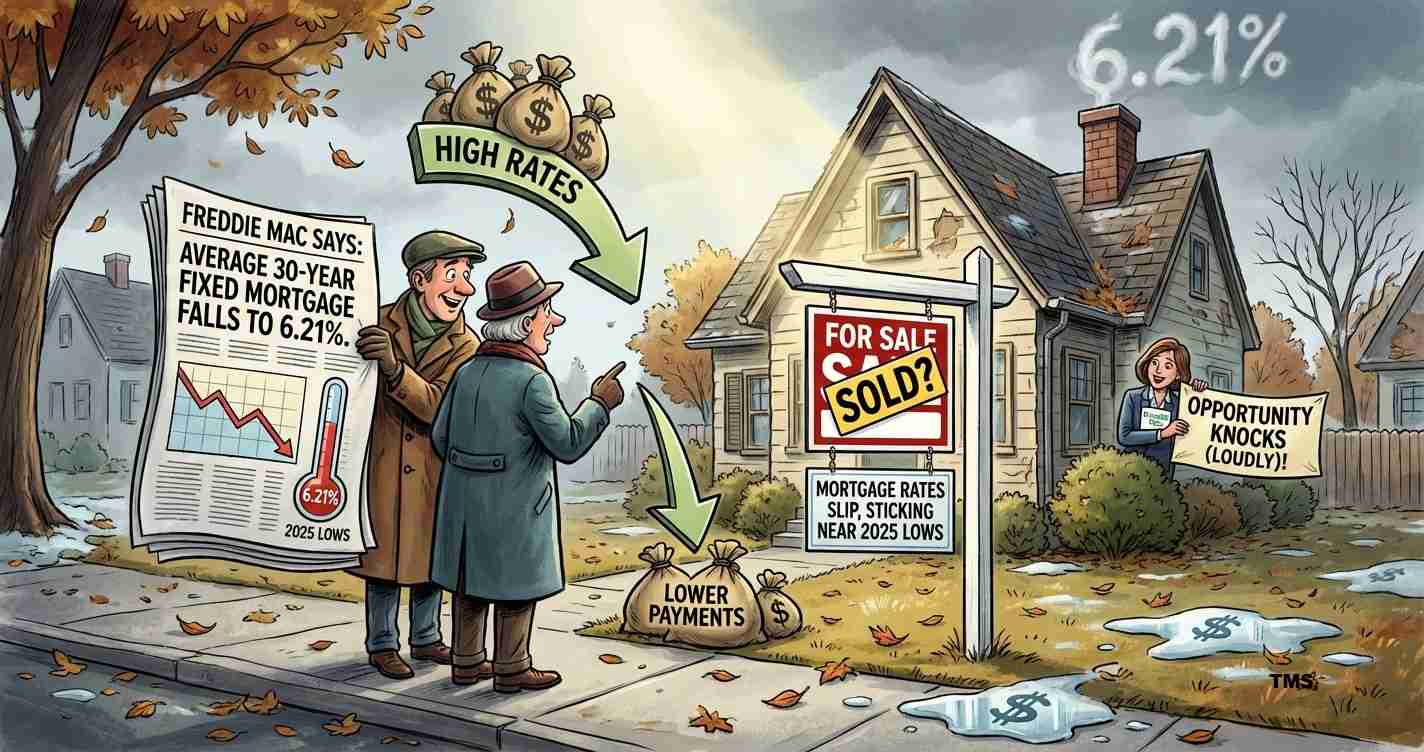
Mortgage rates slip, sticking near 2025 lows as Freddie Mac’s 30‑year fixed falls to 6.21% while 10‑year Treasury steadies near 4.12%
Mortgage rates edged down, holding near 2025 lows as Freddie Mac’s average 30‑year fixed reached 6.21%, while the 10‑year Treasury steadied around 4.12% after a recent 25‑basis‑point Federal Reserve cut — a dynamic that shapes borrowing costs and local markets.
- Freddie Mac’s weekly Primary Mortgage Market Survey shows the average 30‑year fixed at 6.21% on Dec. 18, 2025, among the lowest readings of the year — Freddie Mac’s weekly Primary Mortgage Market Survey.
- The Federal Reserve lowered the federal funds target by 25 basis points to 3.50%–3.75%; that affects short‑term borrowing but does not mechanically set long‑term mortgage rates — see the Federal Reserve H.15 releases.
- Long‑term mortgage pricing tracks the 10‑year Treasury (near 4.12%), producing the historical ~1.5–2.5 percentage‑point spread to 30‑year mortgage rates.
What the numbers show
Freddie Mac’s weekly Primary Mortgage Market Survey (Dec. 18, 2025) recorded the 30‑year average at 6.21%, unchanged from the prior week and down from roughly 6.60% a year earlier. See the Mortgage News Daily summary and the St. Louis Fed FRED series MORTGAGE30US for the underlying readings.
Daily trackers show a tight December range (about 6.19%–6.22%), while other consumer surveys — including Mortgage News Daily, Bankrate and The Mortgage Reports — converge on modestly lower rates.
Why the Fed cut didn’t translate directly into lower mortgage rates
The Federal Reserve’s policy action — lowering the federal funds target to 3.50%–3.75% — influences overnight borrowing and short‑term loan costs but does not mechanically set 30‑year mortgage rates. Long‑term rates are formed by market expectations about growth and inflation and by investor demand for mortgage‑backed securities (MBS) and U.S. Treasuries. See the Fed H.15 release for yield context.
Market expectations matter: when traders expect weaker growth or lower inflation, long yields can fall and pull mortgage rates down; if expectations remain for stronger growth or sticky inflation, long yields — and mortgage rates — may not move much.
The 10‑year Treasury and the mortgage link
Lenders price mortgages with the 10‑year Treasury as a reference because investors compare MBS returns with Treasury yields. Historically, the 30‑year mortgage tends to be about 1.5 to 2.5 percentage points higher than the 10‑year yield. With the 10‑year near 4.12%, a conventional 30‑year mortgage around 6.2% fits that spread.
That spread compensates for credit risk, prepayment risk, servicing costs and investor appetite for MBS. When demand for MBS rises, spreads can compress and mortgage rates fall; the reverse can also occur. Current steady demand plus moderate long‑term yields has kept 30‑year fixed rates near their 2025 lows.
Other rate measures and product notes
Consumer trackers in mid‑December showed 15‑year fixed rates in the low‑ to mid‑5% range (about 5.5%), while some FHA and VA 30‑year sheets listed rates around or just under 6.1% at select lenders. Borrowers who qualify for shorter terms or government‑backed loans may see lower monthly payments, whereas many conventional borrowers reference the 6.21% benchmark. (Sources: The Mortgage Reports, Mortgage News Daily.)
What this means for buyers and refinancers
Buyers: modestly lower rates can slightly improve borrowing power, but local prices and inventory remain the primary drivers of affordability. Get prequalified, monitor listings and compare quotes from multiple lenders.
Refinancers: calculate break‑even time by comparing closing costs, the rate differential and how long you plan to stay in the home. Often, a refinance makes sense only if you expect to remain in the property long enough to recoup fees (see Bankrate guidance).
Implications for San Luis Obispo, California
Economic impact
San Luis Obispo County’s housing market is tight, with home prices above many California and national averages. A small decline in mortgage costs — Freddie Mac’s 30‑year near 6.21% — can give some buyers more purchasing power, but lower rates alone rarely change market dynamics where supply is constrained. Local sellers and builders will watch whether the rate dip sparks more buyer demand in early 2026.
Political consequences
Local officials and housing planners may face renewed pressure to accelerate housing production if lower financing costs stimulate buyer interest. Debates over zoning, affordable housing incentives and permitting timelines could intensify as councils consider supply responses.
Social effects
If buyer demand rises, rental markets could tighten — especially near Cal Poly and downtown neighborhoods — putting pressure on rents. For retirees and older homeowners, modestly lower rates might make refinancing or downsizing more attractive only if suitable local homes are available and affordable.
Cultural relevance
In a community that values small‑town character and environmental quality, any shift that brings more buyers or development can spark cultural debates. Voters and neighborhood groups may weigh tradeoffs between affordability and preserving landscapes and downtown character.
Practical applications for residents
- Buyers: get prequalified, monitor local inventory and compare rate quotes from multiple lenders; a 6.21% benchmark could slightly ease monthly payments.
- Refinancers: calculate break‑even time and factor closing costs; lower rates can make sense for longer stays.
- Policymakers: watch market signals and consider housing supply initiatives if buyer activity increases.
Sources and data used in this report
Reporting drew on mortgage surveys, Treasury yield data and Federal Reserve releases. Key sources include: