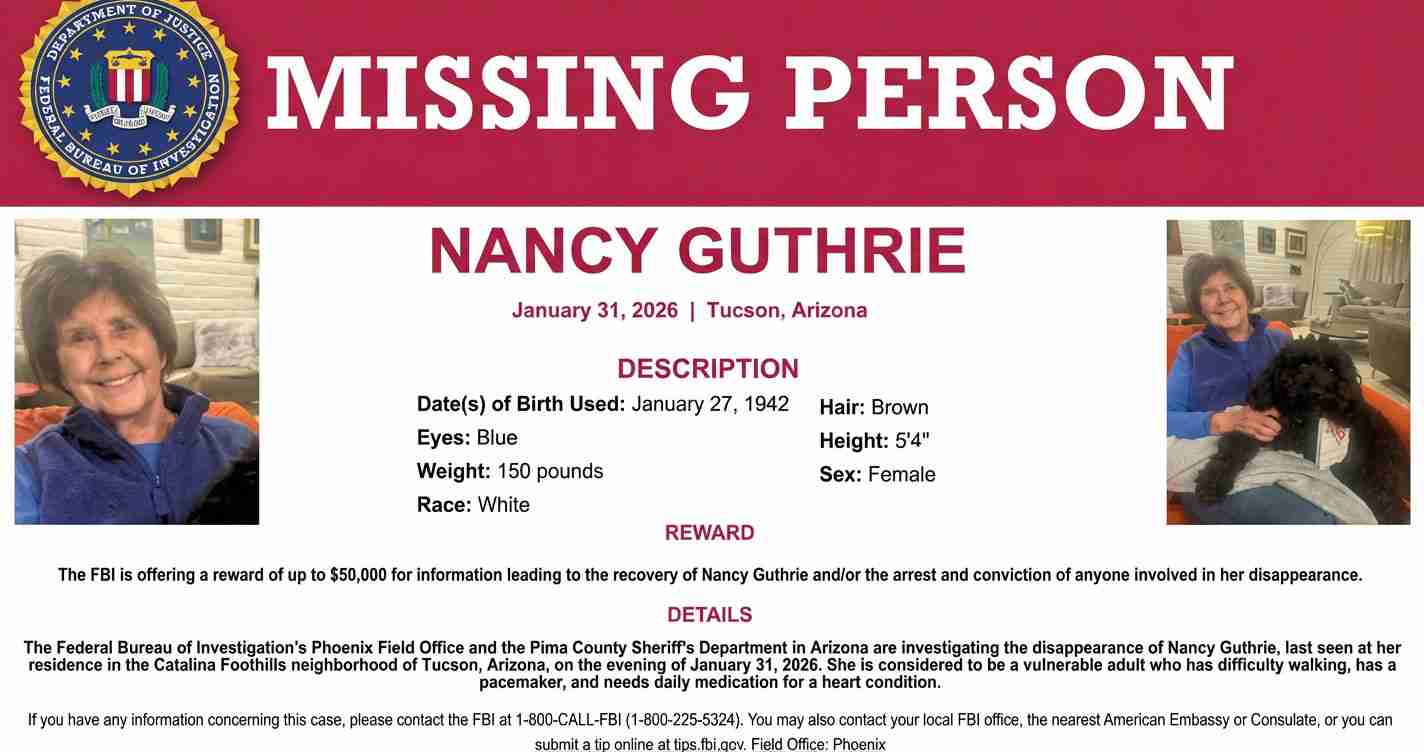
Pacemaker data pins narrow window in Nancy Guthrie disappearance — but devices can’t track location
Nancy Guthrie, 84, disappeared from her Tucson home after being dropped off about 9:45 p.m. on Feb. 1, 2026; pacemaker app logs and doorbell footage helped narrow the likely abduction window for investigators and authorities.
Key takeaways
- Critical timestamps: Doorbell camera activity and a pacemaker-app disconnection at 2:28 a.m. helped narrow the likely time of disappearance (NBC Montana, KATV).
- Physical evidence: Blood on Guthrie’s porch was confirmed to be hers, elevating the probe to an abduction and prompting FBI involvement (NBC Montana).
- Limits of device telemetry: Pacemakers record cardiac and device data but do not provide GPS or location information — useful for timing but not location.
- Ongoing investigation: Ransom notes demanding Bitcoin and a $6 million payment, recovered security footage, and hundreds of investigators continue to drive the active search (KATV).
Timeline and evidence
Last known movements: Guthrie was dropped off at her Tucson home at about 9:45 p.m. on Feb. 1, 2026; her garage door closed near 9:50 p.m. — details reported by regional outlets (NBC Montana, KATV).
Security device timeline: Investigators report the doorbell camera was disabled at about 1:47 a.m., motion was logged at roughly 2:12 a.m., and the pacemaker app logged a disconnection at 2:28 a.m. — anchor points used to narrow the abduction window (NBC Montana, KATV).
How pacemaker data helped investigators
Investigators cited a key entry from Guthrie’s pacemaker app: a recorded disconnection at 2:28 a.m. on Feb. 1, 2026. That log — combined with doorbell-camera anomalies and motion triggers — helped detectives narrow the likely time of the incident, the Pima County Sheriff’s Department said (NBC Montana, KATV).
Medical context: Pacemakers are implanted, battery-powered devices that stimulate the heart as needed. As Amy Kleinhans, lead nurse practitioner for an electrophysiology group, summarized:
“Pacemakers trigger the heart to beat when it’s time to beat.”
When remote monitoring is active, clinics can receive alerts for serious cardiac events; when the connection ends, that external telemetry stops even though the pacemaker continues to function.
Limits: pacemakers can’t be used to track a person’s location
Crucial limitation: Pacemaker telemetry records cardiac rhythm and device function — not GPS coordinates. Law enforcement cannot use a pacemaker to determine where a person was taken or moved. Pima County officials emphasized the disconnection did not impair the device’s ability to stimulate Guthrie’s heart but did stop new remote alerts after 2:28 a.m. (NBC Montana, KATV).
Past cases and public perception
Device logs have been used in prior investigations to help establish timing of deaths or medical events, which has increased public attention to what implanted devices can and cannot reveal. Journalists and experts caution against overinterpreting telemetry — media reports may cite names or specifics that are not verifiable in open-source reporting. In the Guthrie case, outlets reported only the app’s disconnection timestamp and did not publish detailed heart-rhythm data (NBC Montana).
Doorbell video, backend recovery and what it showed
Although the doorbell camera appeared disabled, FBI agents recovered residual backend footage and released clips about 10 days after the disappearance. The released video shows a person wearing long sleeves and pants, a backpack, and a glove covering the camera lens; the individual appears to place potted plants to block the view and moves with their head down. Federal and local officials asked the public to identify the person of interest (NBC Montana, KATV).
Ransom notes, Bitcoin demand and family response
Authorities report multiple ransom notes were left; one note directed to local TV stations demanded $6 million in Bitcoin by Feb. 9 and included threats to Guthrie’s life. The family has publicly appealed for information; her son posted a message asking the captor to make contact. The FBI offered a reward as the probe expanded (NBC Montana).
Investigative steps and status
Hundreds of investigators have worked the case. Authorities searched a person-of-interest’s vehicle and home following a traffic stop in Rio Rico (about 60 miles south of Tucson); that individual was later released without charges. Investigators continue to review digital records, surveillance footage, and physical evidence while following leads in and beyond Tucson (KATV).
Technical and cybersecurity perspectives
Analysts note that homeowner devices can show gaps when cloud uploads are inactive or subscriptions lapse. The Guthrie doorbell footage demonstrates that backend servers can retain recoverable data even when local video appears disabled. Experts recommend homeowners understand device storage, subscriptions, and how law enforcement may recover footage during criminal investigations — a point illustrated in public technical briefings and analyses (YouTube briefing (ClUp2VsKAs4), YouTube briefing (iLppBULS9yI)).
Implications for San Luis Obispo, California
Economic impact: High-profile crimes often increase demand for private security and monitoring services. Local vendors in San Luis Obispo who install cameras, alarms or monitoring systems could see more business as homeowners weigh upgrades.
Political consequences: The case raises questions about elder protection, public-safety resources, and coordination between county and federal agencies. Policymakers may face pressure to clarify protocols when investigations cross jurisdictions.
Social effects: Communities focused on senior safety may increase outreach and neighborhood check-ins. Families and civic groups could expand volunteer or check-in programs for older residents who live alone.
Cultural relevance: National attention on the disappearance — in part because of Savannah Guthrie’s profile — may spur local media and civic groups in San Luis Obispo to lead public-education efforts about device capabilities and limitations.
Practical actions for residents: Homeowners should review how devices store data, confirm cloud backups, and consult clinics about remote monitoring for implanted medical devices. Law enforcement can advise on preserving digital evidence, such as avoiding unplugging devices or overwriting cloud footage.
Reporting and sources
This report is based on timelines and statements from the Pima County Sheriff’s Department and regional reporting, which detail the doorbell-camera timeline, the pacemaker app disconnection at 2:28 a.m., the presence of blood on Guthrie’s porch, ransom notes, and FBI involvement (NBC Montana, KATV).
Additional technical videos and briefings are available online (YouTube briefing (iLppBULS9yI), YouTube briefing (ClUp2VsKAs4)).
If you have information related to this case, authorities urge you to contact the Pima County Sheriff’s Department or the FBI; officials asked anyone who recognizes the person shown in released footage to come forward.