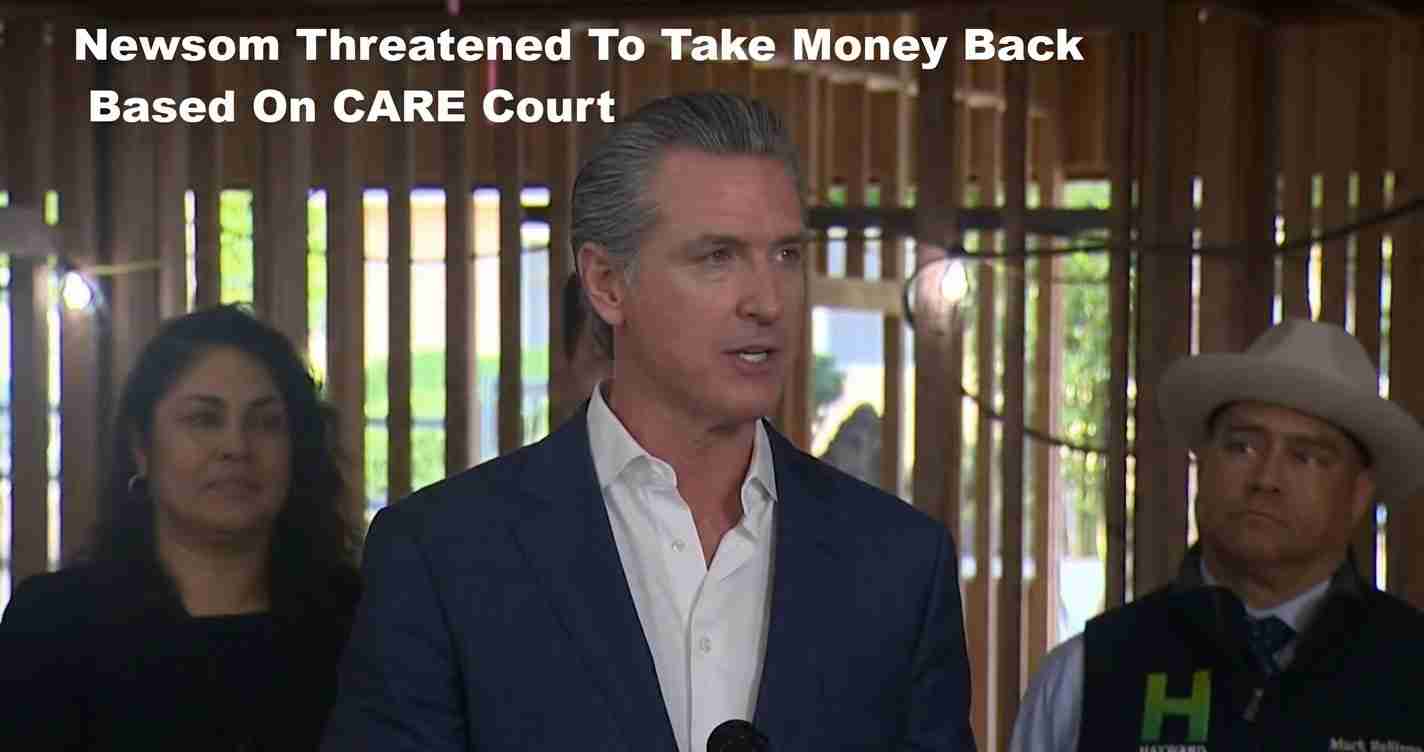
Newsom threatens to redirect CARE Court funding from 10 counties he calls ‘CARE ICU’ over slow rollout
Governor Gavin Newsom warned March 2, 2026, he may redirect CARE Court funds from 10 California counties he dubbed the “CARE ICU” for failing to meet petition benchmarks intended to link people with severe mental illness to treatment.
Key takeaways
- Benchmark: The state set a target of 6.2 CARE Court petitions per 100,000 residents as its measure of rollout success.
- Counties named: Ten counties — Fresno, Kern, Los Angeles, Monterey, Orange, Riverside, San Bernardino, San Francisco, Santa Clara and Yolo — were listed as underperforming.
- Possible funding shift: Newsom said he could propose redirecting funds in his May 2026 revised budget, subject to legislative approval.
- Transparency tool: The state launched a public tracker at accountability.ca.gov to show county progress.
Main story
What is CARE Court and how it reached statewide launch
CARE Court — short for Community Assistance, Recovery, and Empowerment Court — is Governor Newsom’s signature program to connect people with severe mental illness and homelessness to housing, medication and services through voluntary agreements or court-ordered plans. The initiative was announced in 2019, piloted in select counties in 2023 and reached statewide rollout by late 2024 or early 2025. For further context see the KFIA report.
State projections and early results
The state initially projected CARE Court could serve 7,000–12,000 people per year. Since launch, official tallies show 3,817 petitions received, 893 treatment agreements approved and 32 court-ordered plans. More than 4,000 referrals were redirected to other services. Independent reporting and advocates say long-term outcomes remain untracked publicly; read the original coverage in the KFIA article.
Why Newsom singled out the “CARE ICU”
At a March 2 press event at a Bay Area mental health facility, the governor warned counties that do not meet the 6.2 petitions-per-100,000 benchmark could lose state funding, which could be redirected to higher-performing jurisdictions. He framed the move as accountability and said,
“I’m happy to redirect every damn penny… to the counties that are getting things done.”
The governor’s remarks and event footage are available in a press conference video.
Who was listed as underperforming and how they responded
The state named these 10 counties as falling short in 2025: Fresno, Kern, Los Angeles, Monterey, Orange, Riverside, San Bernardino, San Francisco, Santa Clara and Yolo. County leaders pushed back:
- Kern County officials defended their implementation and said they are expanding access (see KFIA coverage).
- Santa Clara leaders argued the single petition metric misses prevention and diversion work already in place (report).
- San Francisco pointed to decreases in encampments and increased shelter and treatment access, while noting tragic individual cases and the recent death of Connor Keith after a dismissed CARE Court case (KFIA story).
- Orange County said it had the fifth-highest petition rate statewide and reported 79 participants in housing and services.
Critics say the metric is too narrow
Several county leaders and associations argue a single petitions-per-capita metric ignores local variation, prevention programs, and diversion systems built before CARE Court. The County Behavioral Health Directors Association criticized the measure for not recognizing earlier efforts; related remarks can be seen in a video of association statements. The California State Association of Counties also urged flexibility for local implementation approaches.
State awards to CARE Champions and other funding moves
Alongside the warning, the administration named 10 “CARE Champions” — Alameda, Humboldt, Imperial, Marin, Merced, Napa, San Mateo, Santa Barbara, Sutter and Tuolumne — and announced awards to support implementation. The state highlighted $131.8 million in Homekey+ funds for 443 homes and $159 million in Homeless Housing, Assistance and Prevention funds from the 2024–25 budget, tied to CARE Court integration. The administration framed these awards as part of a broader strategy that includes Proposition 1 bond funding for behavioral health housing and treatment; see the KFIA report for details.
What the data show so far
State figures indicate modest early use: 3,817 petitions filed, 893 treatment agreements approved, and 32 court-ordered plans, with more than 4,000 referrals diverted to other services. Independent reporting questions whether CARE Court has reached the scale the state first projected; see the original KFIA article. The administration’s public dashboard at accountability.ca.gov is intended to provide ongoing transparency.
How funding redirection would work
Newsom said he could include proposals in his May 2026 revised budget to transfer CARE Court or related homelessness housing dollars away from underperforming counties toward those meeting benchmarks. Any reallocation would require Legislative approval. The governor described the approach as both carrot and stick: awards and praise for high performers and the threat of redirected funds for low performers. Video of the announcement and related remarks are available in a YouTube clip.
Implications for San Luis Obispo, California
Economic impact: San Luis Obispo County is neither listed among the “CARE ICU” nor the “CARE Champions.” Still, any statewide redirection of CARE Court or homelessness housing funds could shift regional grant competition, affecting budgets for outreach, housing projects and partner services.
Political consequences: Local officials may face pressure to demonstrate measurable CARE Court progress or present strong local alternatives. The public dashboard at accountability.ca.gov gives residents a way to track county performance, potentially making CARE Court an electoral issue.
Social effects: Residents who are unhoused or have severe mental illness could see changes in service availability depending on how the state reallocates resources; local providers should watch whether redirected funds flow into or away from regional partners.
Cultural relevance: San Luis Obispo’s mix of rural and small-city communities values tailored local services; a single statewide benchmark may clash with prevention-focused local strategies.
Practical applications: Local leaders should review the state dashboard at accountability.ca.gov and document how prevention, outreach and treatment programs — court-linked or not — reduce homelessness and improve behavioral health outcomes (see local reporting in the KFIA coverage).
Voices to watch and next steps
County behavioral health directors, supervisors and advocates in San Luis Obispo and neighboring counties will likely weigh in as the May budget proposal approaches. The statewide debate will focus on whether a petitions-per-capita benchmark fairly measures progress or unfairly penalizes counties with different local strategies. Residents and officials should follow public data releases and the accountability.ca.gov dashboard to track CARE Court funding and implementation.
Sources: reporting and public documents summarized from the KFIA article, the state dashboard at accountability.ca.gov, and related event videos on YouTube and YouTube.