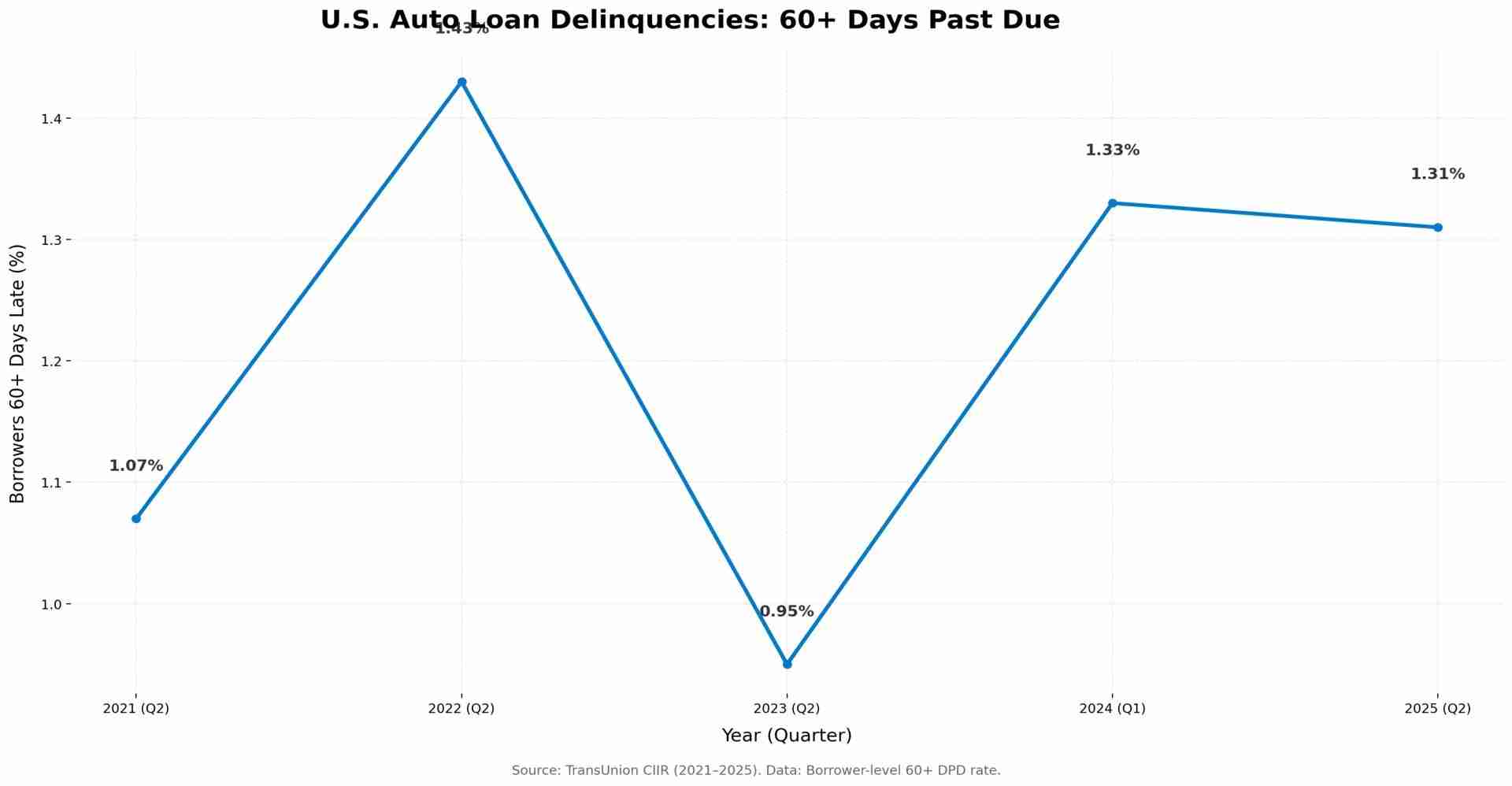
More Americans falling behind on auto loan payments as delinquencies climb
New data show a worrying uptick in auto loan delinquencies as more Americans fall behind on payments, with 90-day delinquencies, rising average balances and lower credit scores signaling mounting strain on household budgets and borrowing costs nationwide.
Key takeaways
- Serious delinquencies rose: As of Q2 2025, 5.0% of outstanding auto debt was at least 90 days late — a growing share of loans in deep delinquency per LendingTree.
- Thirty-day delinquencies stable: 30-day delinquencies held at 8.0% in Q2 2025, roughly the same as a year earlier (LendingTree).
- Balances and scores shifting: Average auto loan balances rose by more than $400 year-over-year and the average VantageScore fell to 701 (VantageScore).
Rising delinquencies in plain terms
Recent industry data make the trend clear: more borrowers are missing car payments and a growing share of accounts are moving into serious trouble. Lenders categorize loans as delinquent when payments are late — a 30-day delinquency means one month past due; a 90-day delinquency means three months late and often precedes repossession and meaningful credit damage.
“These numbers indicate more accounts are sliding into deeper trouble.” — data trend highlighted by industry reports.
LendingTree reports that 5.0% of outstanding auto debt was at least 90 days late in Q2 2025, up from the same period in 2024. Thirty-day delinquencies were 8.0% in Q2 2025, roughly matching last year’s level but down from late‑2024 spikes (LendingTree).
Why payments are getting harder
Multiple forces are tightening household budgets:
- Higher interest rates boost monthly payments for new loans and refis.
- Rising loan balances: average auto loan balances increased by more than $400 year-over-year, pushing monthly costs higher (VantageScore, LendingTree).
- Wages lagging: pay growth has not kept pace with added transportation costs for many families.
- Student debt resuming: repayments that paused during pandemic relief have returned, adding a monthly bill that can crowd out car payments (VantageScore, NBC Palm Springs).
Credit mix and who’s most at risk
Most new retail vehicle financing remains concentrated among prime and super-prime borrowers, but lower-credit buyers face higher rates or resort to riskier channels. Buy-here, pay-here lenders have expanded in used-car markets, offering access but often at high cost and aggressive collections (LendingTree).
VantageScore’s CreditGauge shows the average VantageScore dropped to 701, reflecting how rising delinquencies press down overall creditworthiness (VantageScore).
Lending and market trends
Banks hold the largest share of auto financing at 29.9%, with credit unions and captive lenders following. The growth of used-vehicle financing has expanded subprime and buy-here, pay-here markets, which helps explain some upward movement in serious delinquencies (LendingTree).
Practical steps for borrowers
Industry experts recommend clear, proactive steps to reduce the risk of falling behind:
- Shop for the best rate: get preapproved before visiting a dealer to compare offers and avoid costly dealer markups.
- Avoid last-minute financing: don’t assume dealer financing is the best option without comparing terms.
- Talk to your lender early: if payments become difficult, inquire about hardship programs or alternative arrangements rather than letting accounts default (LendingTree).
- Use credit counseling: nonprofit credit counselors can help evaluate realistic options and budgets.
How rising delinquencies affect credit and borrowing
Late auto payments can lower credit scores, increasing the cost of future borrowing and limiting access to low-rate loans. The drop in the average VantageScore to 701 underscores this dynamic (VantageScore).
Consumer protections differ by state: repossession rules, grace periods, and cure options vary, so borrowers should review loan contracts and state laws and consider contacting local consumer advocates or counselors for help.
Local models and what people are buying
Popular financed vehicles include the Ford F-150, Chevrolet Silverado 1500, and Toyota RAV4 — larger and mid-size models that often carry higher sticker prices and financing needs, contributing to rising balances (LendingTree).
Implications for San Luis Obispo, California
Economic impact: San Luis Obispo County families may cut discretionary spending as rising car payments and interest costs squeeze household budgets, affecting local retail, dining and services.
Local jobs and transportation: repossession or loss of vehicles risks commuting instability in a region with limited transit, threatening access to work, school and healthcare—especially for agriculture, hospitality and small-business workers.
Housing and household budgets: higher monthly car payments can crowd out rent or mortgage payments in an already tight housing market, increasing demand for rental assistance or shared housing.
Policy responses: local officials, nonprofits and lenders could expand outreach, financial counseling, preapproval education and commuter-support programs. Employers might explore commuter benefits or carpool incentives to reduce costs for workers.
Students and young borrowers: communities with sizable student populations, such as Cal Poly, may see younger borrowers disproportionately harmed as they juggle resumed student loan payments and car financing.
Practical local steps include lender-led educational sessions, employer commuter programs, and targeted outreach by community credit counselors and San Luis Obispo credit unions offering lower-rate options.
Sources and data caveats
This article draws on industry data and reporting. Key sources include:
- LendingTree: Auto debt and delinquency statistics and market-share analysis.
- VantageScore: CreditGauge report on balances, delinquencies and score trends.
- NBC Palm Springs: Reporting on repayment pressures and local impacts.
Data caveats: industry reports use different reporting methodologies and time frames; figures reflect Q2 2025 industry data and comparisons to prior periods. Readers should consult the original sources for detailed tables and methodologies (LendingTree, VantageScore).
Additional resources
For local help in San Luis Obispo, contact community credit counseling agencies, area nonprofit organizations that provide financial education, and local credit unions. Review consumer guides from LendingTree and VantageScore to understand options and next steps.
Sources