Democrats Shift From Impeachment to Courtroom Fights as Article II Battles, Portland National Guard Deployment Test Presidential Power
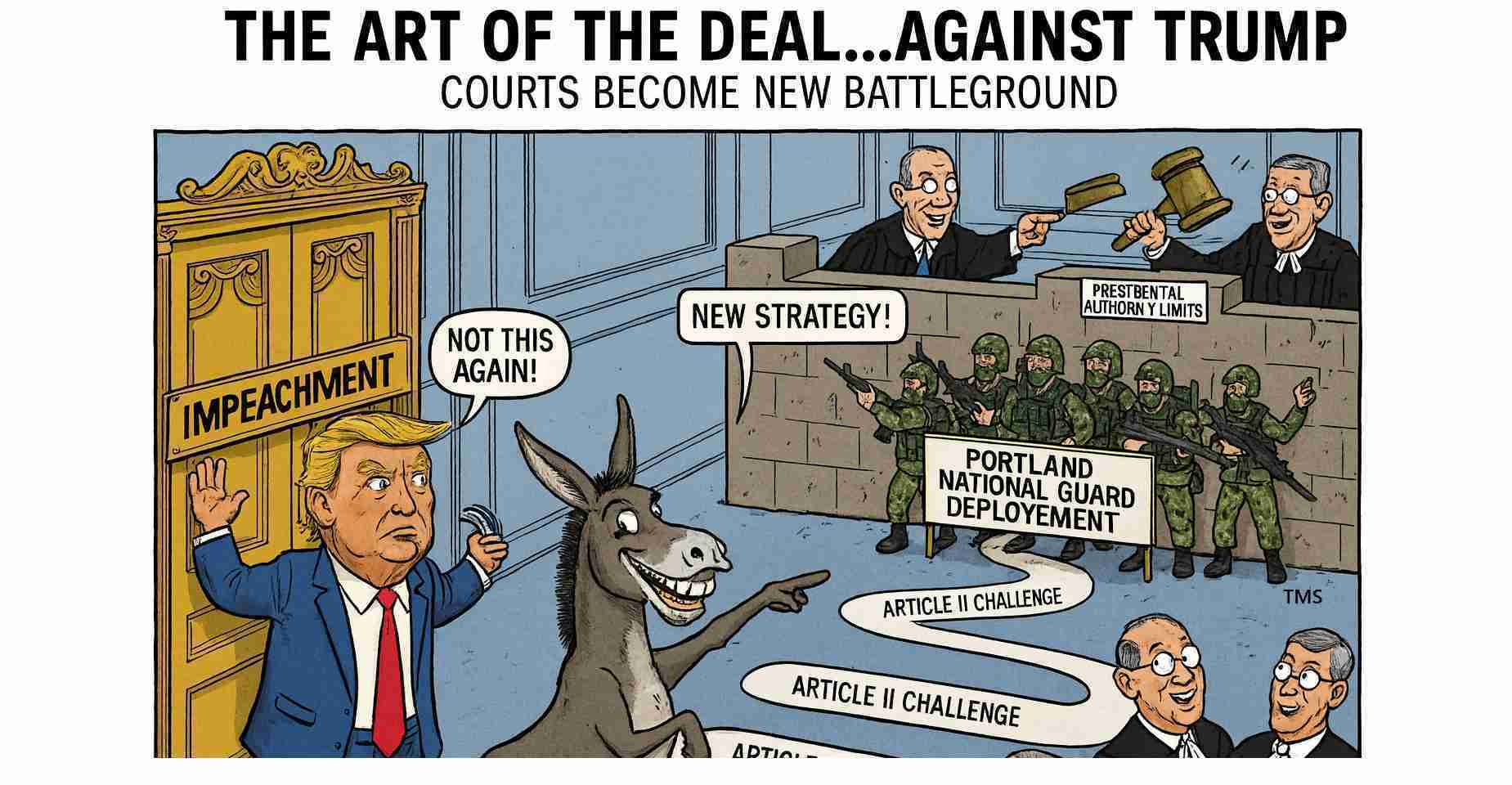
Opponents of President Trump are increasingly using constitutional lawsuits under Article II to curb executive actions, shifting from impeachment to federal courts. High-profile disputes such as the Portland National Guard deployment are shaping the legal boundaries of presidential power.
- Democrats and civic groups favor litigation over impeachment to win immediate injunctions and limits on controversial orders.
- The core dispute centers on Article II and whether the president may act unilaterally to override statutes or court orders.
- The Portland National Guard deployment is a key test case now entangled in federal lawsuits and injunctions.
- Outcomes in dozens of suits will shape future separation-of-powers precedent and executive-congressional relations.
What is at stake: Article II and executive power
Article II vests the president with “the executive power” but does not enumerate every limit. That constitutional brevity has opened a wide field of litigation testing how far a president can act alone and when actions require statutory authority, congressional approval, or judicial restraint.
Legal scholars warn these suits test whether Article II can be read to permit actions that effectively override laws, control spending, remove officials, or deploy federal forces inside U.S. cities.
Why opponents moved from impeachment to Article II challenges
Impeachment is inherently political and requires congressional majorities and a Senate trial. By contrast, litigation can produce immediate judicial relief—temporary restraining orders and injunctions—that halts administrative action while courts resolve legal questions.
Many suits rely on statutes such as the Administrative Procedure Act, the Civil Service Reform Act, and the Impoundment Control Act to frame executive actions as arbitrary, unlawful, or beyond agency authority (see Just Security tracker).
Portland National Guard deployment becomes a test case
The Portland deployment illustrates the constitutional clash: the administration contends Article II supports federal and Guard operations in the city, while opponents argue such use of forces for domestic law enforcement lacks legal basis.
“Courts are now deciding whether the president can assert near-unchecked authority to send federal forces into cities and direct them in ways that bypass Congress or local law.”
That litigation has produced injunctions and extensive briefing on separation-of-powers questions (coverage and analysis: The Regulatory Review).
Other major legal fronts and cases
Beyond Portland, key litigation areas include:
- Technology and national security: disputes over bans and restrictions on apps like TikTok test unilateral presidential action on foreign-threat grounds (analysis: Lawfare).
- Employment and civil service: fights over removal powers and precedents such as Humphrey’s Executor that limit the president’s authority to fire certain officials.
- Administrative Procedure Act claims: plaintiffs argue many moves are “arbitrary and capricious” or exceed statutory authority (context: University of Chicago News).
Legal observers counted at least a dozen major suits by spring 2025 challenging asserted Article II powers or related executive actions (The Regulatory Review).
How courts are responding
Judges have issued temporary restraining orders and preliminary injunctions in several high-profile matters, forcing rapid judicial review of sweeping Article II claims. Courts are weighing statutory text, precedent, and constitutional structure to determine whether the president’s assertions hold up.
The judiciary’s pushback has included public admonitions: after the president suggested judges who rule against him could be impeached, Chief Justice John Roberts warned that impeachment is not a response to judicial decisions (coverage: Lawfare).
If courts limit executive claims, these rulings will become binding precedent that curbs future administrations; if courts defer, Article II may be read more broadly going forward.
Project 2025 and preemptive legal resistance
The conservative blueprint known as Project 2025 has spurred preemptive litigation aimed at blocking structural changes before they take effect. Opponents challenge elements of the plan that could expand presidential authority, relying on precedents such as Humphrey’s Executor to contest removal and restructuring schemes (analysis: PRRAC).
Public and political reactions
Responses are mixed. Supporters of court-based strategies say litigation offers practical, near-term checks; critics warn it substitutes judicial fixes for political accountability and legislative tools such as budgets and oversight.
Legal experts caution that reliance on courts is risky if the judiciary’s composition or interpretive approach shifts, but many view litigation as the most immediate way to block actions viewed as unlawful (tracker: Just Security tracker).
Implications for San Luis Obispo, California
Economic impact
Court rulings that limit or expand executive power can affect federal funding and local programs. Changes to enforcement priorities, grant rules, or agency direction could alter budgets for county services, nonprofits, and social programs serving migrants or low-income families.
Political consequences
Local officials may be caught between federal directives and state or municipal law. If federal deployments become precedent, local leaders could face new patterns of federal involvement in protests or unrest—an issue likely to surface in local campaigns and elections.
Social effects and cultural relevance
Broader Article II rulings may change policing strategies, immigration enforcement, and protest response—affecting campus life at Cal Poly and civic events in downtown San Luis Obispo. Residents who value local control may resist perceived federal overreach, while others may welcome stronger federal coordination for public safety.
Practical applications for residents
- Local agencies should monitor federal court decisions and update emergency plans and mutual aid agreements accordingly.
- Nonprofits and service providers must track funding rules and enforcement changes that could affect eligibility or operations.
- Voters and civic participants can raise Article II implications at town halls and during candidate debates to inform local priorities.
Sources and further reading
Preserved original reporting and analysis:
- The Meaning of Article II and ‘Executive Power’ to Trump — Lawfare
- Spotlight: The Uncertain Future of the Separation of Powers — The Regulatory Review
- Trump’s executive orders: How do they work and what’s their legal basis? — University of Chicago News
- Tracker: Litigation challenging the Trump administration — Just Security
- The upcoming legal resistance to Project 2025 and the second Trump administration — PRRAC