Scientists say Easter Island’s Moai “walked” to their places — new research backs Rapa Nui oral tradition
Scientists say new experiments and physics models show Easter Island’s Moai were transported upright by teams using ropes to rock and pivot the statues, validating Rapa Nui oral tradition and reframing monument transport as engineering, not brute force.
- New research: Experiments and modeling show Moai could be moved upright with a controlled rocking “walk.” Local12 coverage and Popular Mechanics report the findings.
- Small crews, big results: Physics-based models and tests indicate teams of ~15–18 people can move replicas efficiently — supported by Live Science and the SSRN paper.
- Design matches function: Quarry evidence and modeling suggest Moai were carved with a forward lean and low center of mass to enable upright transport — see the Arizona experts page and ScienceDaily release.
New research and methods
Lead researchers Carl P. Lipo and Terry L. Hunt synthesize field experiments, physics-based modeling and experimental archaeology to test longstanding Rapa Nui accounts that the figures “walked” from quarry to platform. Their work appears in peer-reviewed outlets and has been summarized in national reporting, including Local12 and Popular Mechanics.
How the “walking” theory was tested
Researchers used a combination of 3D computer modeling, full-size replicas and staged field experiments to evaluate how shape and mass distribution affect movement. Many Moai have D-shaped bases and a deliberate forward tilt; those features permit a controlled rocking-and-pivoting gait.
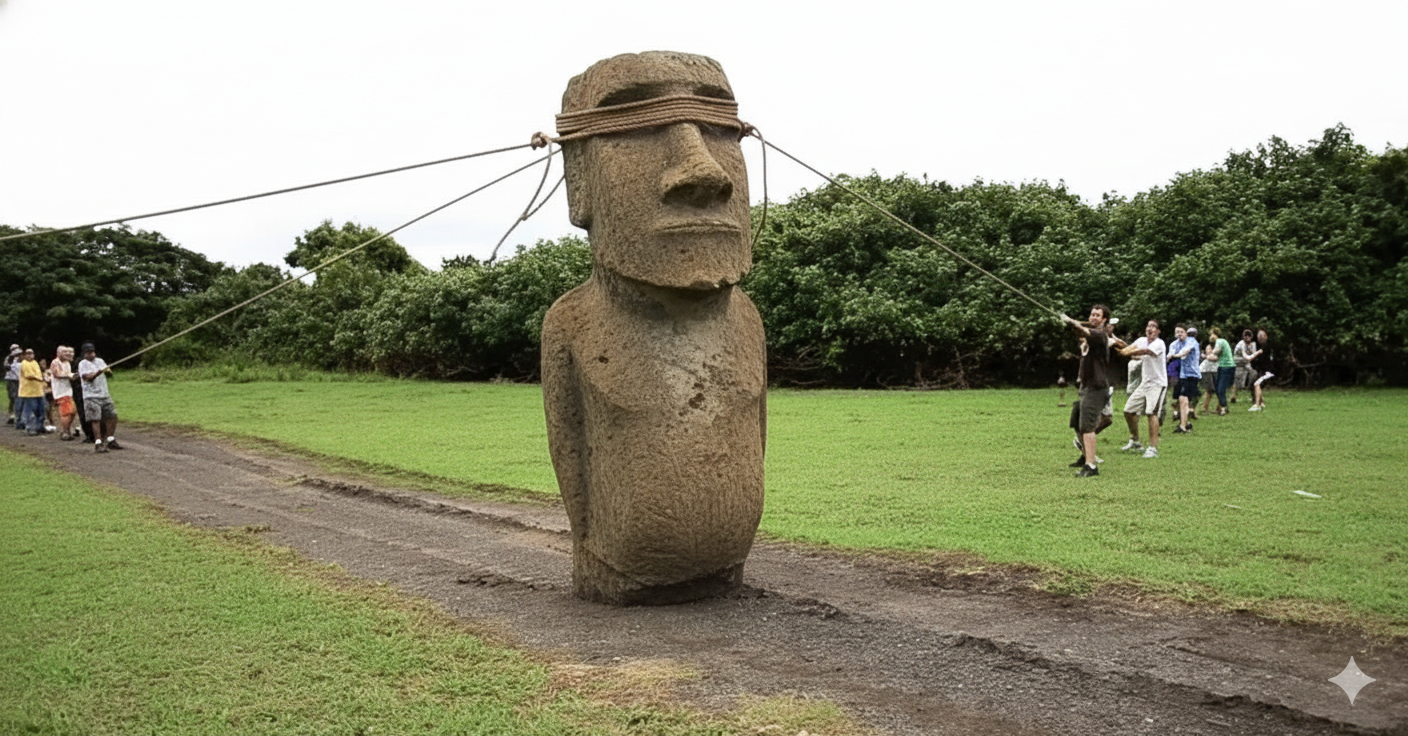
A full-size replica weighing 4.35 metric tons was used in trials where crews attached ropes and alternately pulled to tip and catch the statue, producing a pendulum-like forward step. See the Arizona team summary at the Arizona experts page and paper and field descriptions in Popular Mechanics.
Numbers that change the story
Experimental runs demonstrated surprising speed: a crew of about 15–18 people moved a replica over 100 meters in roughly 40 minutes. Model calculations estimate an average walking speed near 310 meters per hour and roughly 11,000 steps to reach distant platforms ~10 km from the main quarry, per reporting in Live Science.
Larger statues may not have been slower; greater stride length under the walking method could equalize or increase effective speed for bigger figures, according to the models (see the SSRN analysis).
Why this overturns old ideas
Earlier models required large labor forces, rollers, sleds or extensive tree-felling — interpretations that implied environmental stress and social conflict. The walking-method research shows transport could be low-impact, requiring fewer people and no heavy sledges, which reduces the likelihood that Moai transport alone drove ecological collapse. Reporting synthesizing this shift includes Local12 and work summarized by Binghamton University.
The team’s approach centers on pendulum dynamics: modeling how center-of-mass and forward lean affect stability shows many Moai design choices are consistent with intentional upright transport rather than accidental carving traits. See the ScienceDaily release and the detailed analysis on the Arizona experts page.
Experimental archaeology: real-world trials
Field experiments used rope crews to rock and advance replicas with minimal slippage. Success depended on clear communication, ropes on both sides, and prepared paths — not heavy construction crews or wide-scale land clearing. Trial summaries and crew methods are described in Popular Mechanics and Live Science.
The experiments attempted to mirror island topography and soil conditions and drew on quarry evidence showing carvers shaped many incomplete Moai to lower center of mass and add forward tilt early in the carving process.
Respecting Rapa Nui knowledge
Rapa Nui oral tradition has long said the statues “walked” to their platforms. For centuries outside scholars dismissed this as myth. The new findings show indigenous oral history preserved accurate information about transport, and researchers emphasize that recognizing this knowledge matters for future archaeological practice (Local12, Popular Mechanics).
“This research highlights the importance of treating oral tradition as a valid line of evidence alongside experimental and modeling work.”
Cultural and engineering sophistication
Instead of collapse, the research presents a narrative of planning, engineering insight and social coordination: small teams using simple tools executing carefully designed transport. That reframes the Moai as intentional engineered monuments rather than only monumental burdens on the island’s ecology (Live Science).
Implications for San Luis Obispo, California
The discovery has several local angles for San Luis Obispo County — from tourism to education, community projects and cultural programming. It provides a concrete example of indigenous knowledge aligning with scientific methods and suggests actionable connections for local institutions.
Economic and tourism impact
San Luis Obispo County’s mix of outdoor tourism, cultural sites and university-driven visitors could see renewed interest in exhibits or programming on island engineering, experimental archaeology and indigenous knowledge. Local museums and travel businesses might develop talks, displays or special programming tied to the Moai walking research.
Educational and university links
Cal Poly and Cuesta College could incorporate the findings into courses on archaeology, physics and engineering. The walking-method experiments are approachable lab and field examples of pendulum dynamics, cooperative problem-solving and ethical collaboration with indigenous communities.
Cultural and community relevance
This story underscores that oral tradition can hold scientific truth. In San Luis Obispo, it encourages collaboration with regional tribes and storytellers to preserve and share local oral histories alongside scientific interpretation.
Tour operators and visitors
Tour operators can create tie-ins discussing how simple technology and cooperative labor shaped landscapes elsewhere, adding depth to local tours and attracting visitors interested in archaeology, indigenous history and engineering ingenuity.
Practical applications and civic engagement
The research models low-impact, community-based engineering solutions. City planners and non-profits working on low-cost, community-built projects might draw lessons about coordinating small teams and simple tools to accomplish heavy-lift tasks without heavy machinery.
Political and ethical considerations
For a politically moderate audience, the story exemplifies respectful collaboration between science and local knowledge, revising past assumptions without blame and promoting stewardship and thoughtful engagement with history.
Scholarly and museum partnerships
Museums and academic departments could pursue partnerships with Rapa Nui scholars and cultural institutions to ensure programming is culturally sensitive and accurate — for example, joint lectures, student exchanges or traveling exhibits.
Conclusion
Researchers say the Moai were not merely hauled by brute force but engineered to be moved upright in a walking gait. This reframing opens new avenues in education, tourism and community projects in regions like San Luis Obispo that value both science and cultural heritage.