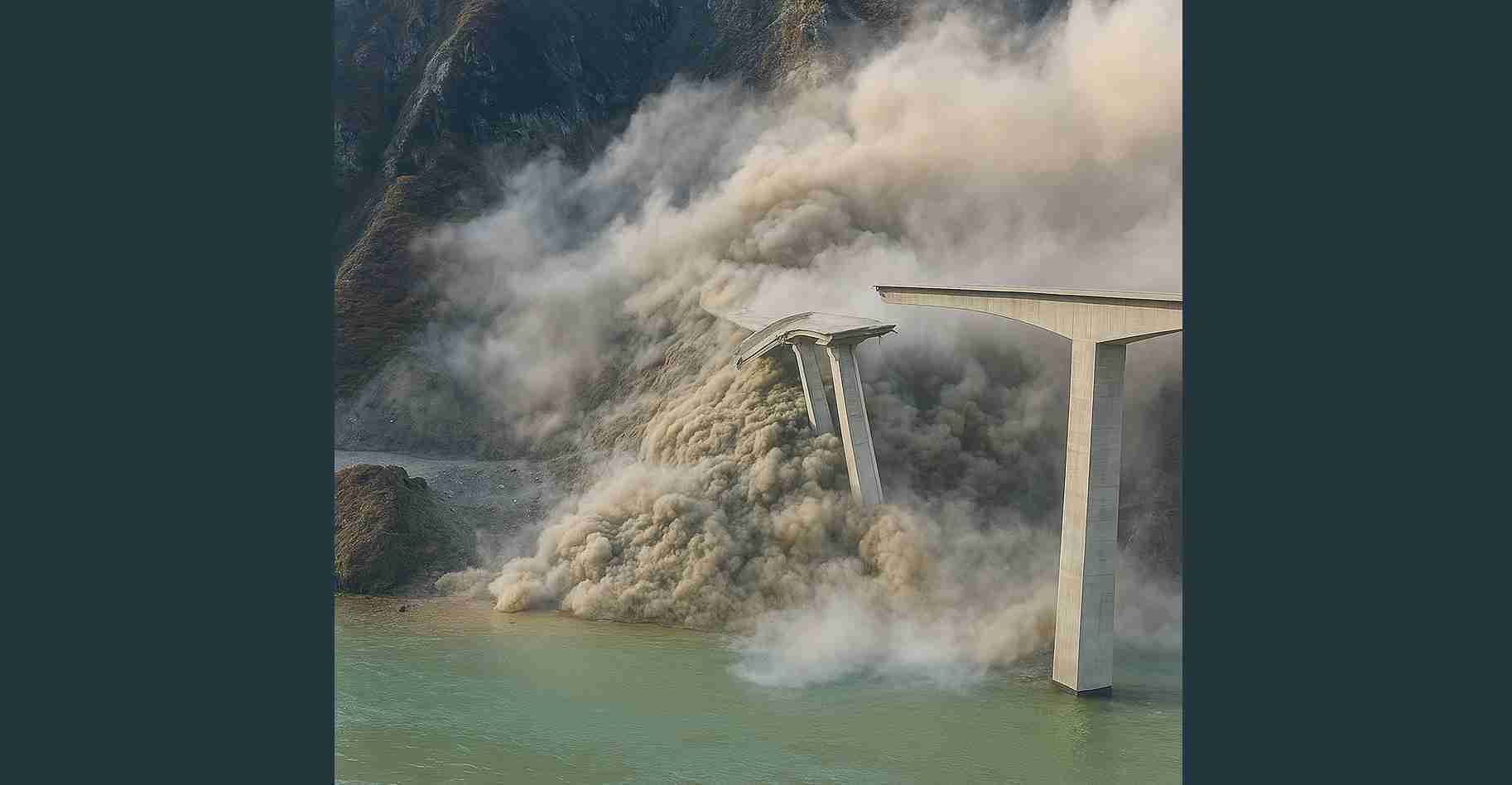
Hongqi Bridge in Sichuan collapses after massive landslide; no casualties reported
The newly built Hongqi Bridge in Sichuan Province collapsed into a river on November 11, 2025, after a massive landslide undermined its supports. Authorities had closed the bridge a day earlier after detecting cracks, preventing casualties.
- Scale of failure: The 758‑meter highway span fell into a ravine after a sudden hillside collapse.
- Precautionary closure: Officials closed the bridge on November 10 after detecting cracks and ground movement, likely averting injuries or deaths.
- Footage and reporting: Multiple widely shared video sources and another video source show the landslide and collapse.
- Questions raised: The incident intensifies scrutiny of geological surveys, monitoring systems and construction oversight in mountainous regions.
What happened: a sudden hillside failure and a collapsing span
Video footage circulating on social platforms shows the hillside near the Hongqi Bridge breaking away in a fast-moving landslide. A wall of earth and rock swept across the ravine, and a large dust cloud engulfed the bridge as sections collapsed into the river. The images show the roadway dropping and twisting as piers and foundations were buried or scoured by debris. See the footage showing the hillside failure.
Local officials closed the bridge after engineers found cracks and ground shifts the day before the collapse. Authorities say that preemptive closure likely prevented any deaths or injuries. Reports indicate the landslide — not an immediate visible failure of the superstructure — was the direct trigger.
Engineering background and the role of terrain
Sichuan Province is known for steep mountains and complex geology. Roads and bridges in this region must balance heavy engineering demands with risks such as landslides, earthquakes and soil instability. The Hongqi Bridge was completed in early 2025 as part of a strategic route linking central China and Tibet; its loss is a major setback for planners.
Experts note that in steep terrain foundations and slopes require:
- Thorough geological surveys and conservative design margins.
- Deep anchors or retaining structures where slopes are unstable.
- Continuous monitoring and contingency planning, including sensors and rapid alert protocols.
Safety checks and the decision to close the bridge
Authorities report detecting cracking and ground movement on November 10, 2025, and they closed the Hongqi Bridge to traffic. That decision likely limited human harm when the slope gave way the next day. Investigators will examine pre-opening inspection records, geotechnical studies used for design, maintenance logs and any sensor or monitoring data.
“Preemptive closure likely averted casualties,” local briefings stated, emphasizing that no injuries or deaths have been reported.
Video and eyewitness accounts
Two widely shared clips capture the hillside collapse and the bridge’s fall. One clip shows the slope breaking in stages before a larger slide, while another records the plume of dust and debris as the span disappears into the ravine. See the video showing the collapse and additional footage of the landslide.
Eyewitnesses and footage describe how quickly the event unfolded, underlining the short detection window for rapidly developing slope failures.
Questions about construction standards and oversight
The collapse has re-ignited debate about infrastructure safety in geologically complex zones. Observers identify three main areas for review:
- Site studies and design margins: Were geological surveys sufficiently thorough and did designs include safety margins for slope movement and extreme events?
- Monitoring and sensors: Were inclinometer, strain gauge or GPS systems installed — and how were alerts handled?
- Construction and maintenance: Were techniques and materials appropriate for high-risk mountain bridges, and were post-opening inspections followed?
Strategic and economic impacts
The Hongqi Bridge was part of a strategic route to improve transport links between central China and Tibet. Losing a key span will disrupt freight and passenger flows, require costly repairs or rerouting, and may slow delivery of goods in the area and complicate related construction projects dependent on this corridor.
Implications for San Luis Obispo, California
Though the accident occurred thousands of miles from California’s Central Coast, officials and engineers in San Luis Obispo County can draw practical lessons:
- Infrastructure resilience and hazard planning: Maintain up-to-date slope sensors, inspection schedules and emergency closure plans for high-risk corridors.
- Construction oversight and public trust: Share transparent inspection records and explain safety measures for major projects in risky terrain.
- Emergency response and closure protocols: Review indicators that trigger preemptive closures — crack growth, unusual ground movement or heavy rainfall — and test coordination protocols.
- Academic and technical collaboration: Use engineering programs and research institutions to study lessons and improve regional resilience.
- Supply chain awareness: Monitor potential global supply impacts from prolonged regional disruptions in China.
Sources and ongoing reporting
This account draws on local video and reporting, including footage posted on YouTube that shows the landslide and collapse. See the primary clips: YouTube clip 1 and YouTube clip 2. Authorities have reported no casualties to date.
Investigations are expected to expand as engineers assess the site, review monitoring data and examine construction records. Times Media Service and other outlets will continue to follow official updates, expert analysis and local responses as new information becomes available.