LaGuardia plane crash: Air Canada Express jet collides with Port Authority fire truck, killing both pilots and injuring dozens
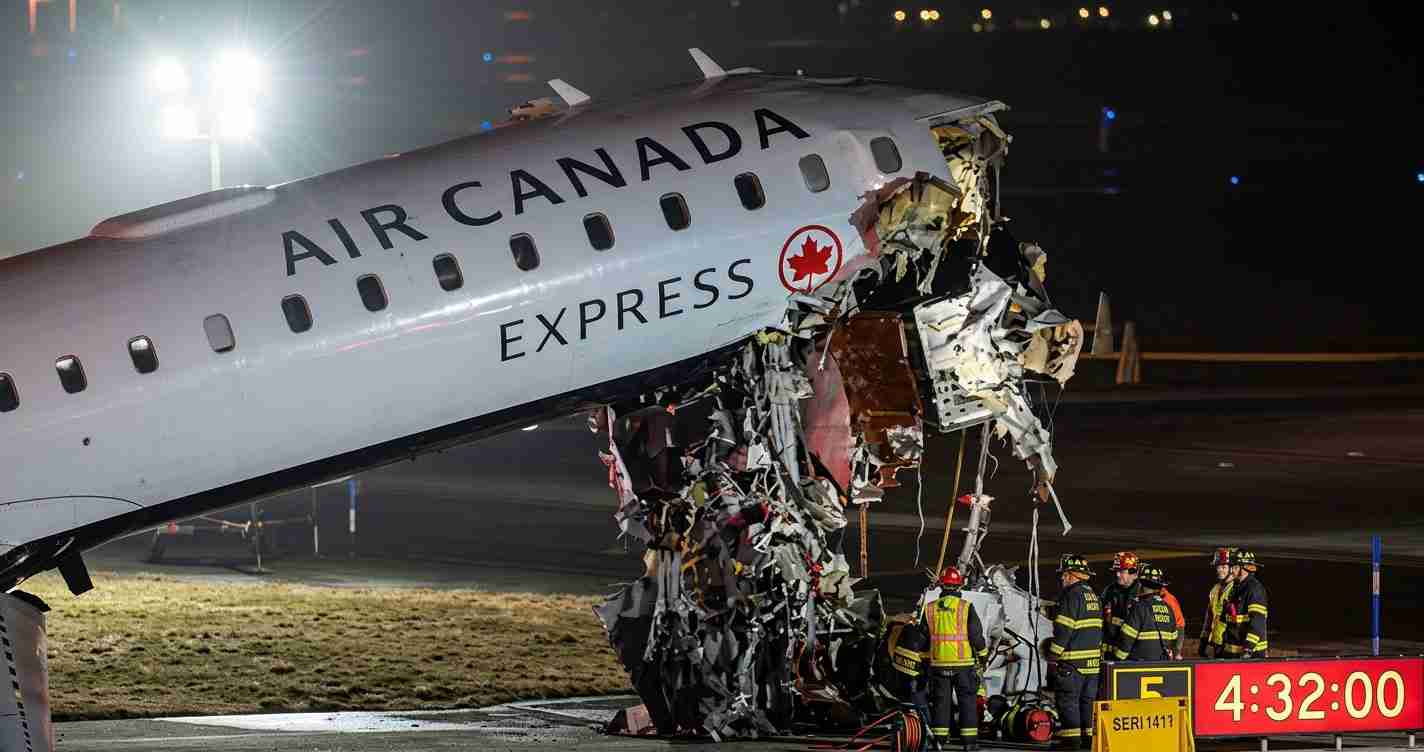
Two pilots were killed and dozens injured after an Air Canada Express CRJ‑900 struck a Port Authority fire truck on Runway 4 at LaGuardia Airport on March 22, 2026, prompting a full closure and an NTSB investigation.
Key takeaways
- Air Canada Express Bombardier CRJ-900 arrived from Montreal and struck a Port Authority fire truck on Runway 4.
- Casualties: Both the captain and first officer were killed; more than 39 passengers and crew and two Port Authority officers were hospitalized (Fox News, ABC News).
- Airport action: LaGuardia closed and the FAA issued a ground stop; reopening was expected after an initial safety review (ABC News).
- Investigation: The NTSB recovered the cockpit voice recorder (CVR) and flight data recorder (FDR) and has begun analysis.
Main coverage
What happened
Shortly before midnight on March 22, an Air Canada Express CRJ-900 arriving from Montreal struck a Port Authority fire truck on Runway 4, authorities said. The fire truck had been deployed to respond to a separate runway incident, according to initial reports (Fox News, ABC News).
The collision was described by officials on scene as severe. The aircraft sustained heavy damage and debris was scattered across runways and nearby taxiways, forcing a full airport closure and an FAA ground stop. The Port Authority said the two officers in the fire truck suffered broken bones and non-life-threatening injuries and were expected to survive (The Jerusalem Post; Fox News).
Casualties and emergency response
Authorities confirmed that both the captain and first officer died as a result of the collision. Jazz Aviation provided a preliminary passenger list confirming 72 passengers and 4 crew members on board, including the captain, first officer and two flight attendants (Fox News).
More than 39 passengers and crew members and two Port Authority officers were taken to area hospitals. Port Authority Executive Director Kathryn Garcia said 32 injured people had been released from hospitals, though some sustained serious injuries (Fox News, ABC News).
Speed reports and possible discrepancies
Early flight-tracking sources reported differing speed estimates at impact. One data source indicated the aircraft was traveling about 24 miles per hour, while another placed the speed between 93 and 105 miles per hour. Investigators will examine the FDR and other records to resolve discrepancies and determine the exact speed and trajectory (ABC News, The Jerusalem Post).
NTSB-led investigation
The National Transportation Safety Board has taken lead on the probe, supported by the FAA and Port Authority investigators. NTSB Chair Jennifer Homendy confirmed the cockpit voice recorder (CVR) and flight data recorder (FDR) were recovered; the CVR was intact and sent to the NTSB laboratory in Washington, D.C., and work on the FDR was set to begin shortly thereafter.
To reach the recorders, responders and investigators cut a hole in the aircraft’s roof. Teams are reviewing multiple evidence sources — surveillance footage, air traffic control communications, and a replay of the airport surface detection system — to reconstruct the seconds before impact. Key investigative questions focus on the positions and movements of the aircraft and the fire truck in the moments prior to collision.
“That is actually what we hope to get from the FDR,” Homendy said, noting the FDR should clarify the aircraft’s final moments.
Investigators cautioned that evidence collection is meticulous and the crash scene spans multiple runways and taxiways, so documenting debris and wreckage could take days before removal (Fox News).
Airport impact and historical context
LaGuardia closed immediately after the collision, disrupting flights at a major U.S. hub and prompting an FAA ground stop. Officials noted this was LaGuardia’s first fatal crash in roughly three decades, renewing scrutiny of runway procedures and emergency coordination. Authorities worked overnight to clear and inspect the scene; runways were expected to reopen after an initial safety review (ABC News).
Implications for San Luis Obispo, California
Economic impact
Although the crash occurred in New York, LaGuardia is a major connecting hub and temporary closures or heightened inspections could ripple through schedules, affecting travelers and regional airlines serving San Luis Obispo County. Local travel businesses — tour operators, hotels, rental car providers — could see short-term disruptions if flights are rerouted or delayed. San Luis Obispo Regional Airport (SBP) may see small shifts in routing or traveler patterns.
Political and regulatory consequences
The incident may prompt renewed scrutiny of runway safety protocols and emergency vehicle coordination. Local and state policymakers in San Luis Obispo could use the event to advocate for updated runway surveillance systems, improved ground-crew training, or additional resources for smaller regional airports.
Social and community effects
Residents with Northeast ties or frequent travelers may face delays and heightened concern about air travel safety. Universities and community groups could see increased inquiries about contingency plans. Local health providers should be aware of potential secondary emotional and mental-health needs among families and first responders.
Cultural relevance
San Luis Obispo’s emphasis on community safety and preparedness means the LaGuardia crash will likely resonate locally. Civic leaders and journalists may press for transparent updates from federal investigators and discussion on applying lessons to regional airports and emergency services.
Practical applications for residents
- Travelers: Check airline updates if you connect through LaGuardia; consider alternate routings and expect possible delays (ABC News).
- Local airports: SBP officials should review runway safety procedures and coordinate with county emergency services to minimize runway-incursion risk.
- First responders: Review interagency communication and situational-awareness protocols for operations on active runways.
- Community leaders: Maintain clear public information channels and support resources for residents affected by travel disruptions.
Ongoing investigation and what to watch for
Investigators will analyze the intact CVR in the NTSB lab and begin work on the FDR. Officials will also review surveillance video, air traffic control audio, and the airport surface detection replay to reconstruct the final seconds before the collision. On-scene evidence collection and wreckage documentation could take several days, and the NTSB said it hoped to release initial findings as the laboratory analysis proceeds (Fox News).
Source attribution and ongoing updates
This report is based on official statements and media briefings, including reporting and briefings from Fox News, ABC News, and The Jerusalem Post. Investigative findings will depend on final NTSB analysis of the CVR, FDR, airport surveillance, and air traffic control records.