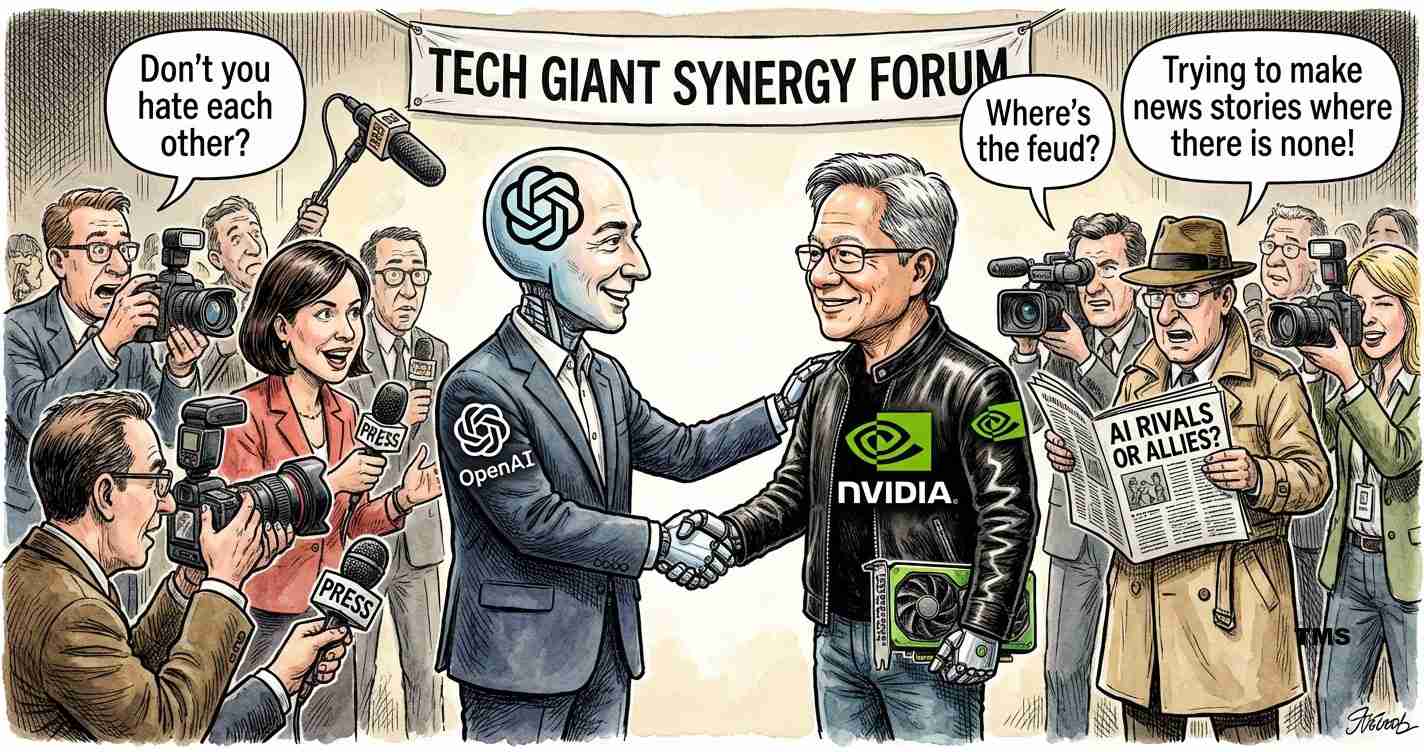
Nvidia CEO Denies $100 Billion OpenAI Deal Has Stalled, Calls Reports ‘Nonsense’ in Taipei
In Taipei on January 31, 2026, Nvidia CEO Jensen Huang denied reports that plans for a $100 billion investment in OpenAI had stalled, calling suggestions he was unhappy with the company “nonsense” and reaffirming Nvidia’s intent to proceed.
- Huang’s denial: Jensen Huang said Nvidia would “definitely participate” in OpenAI’s funding round and invest “a great deal of money.”
- Non‑binding deal: The September 2025 agreement was a non‑binding letter of intent tying investments to compute deployments.
- Reports differ: TechCrunch and other outlets summarized The Wall Street Journal’s account of internal doubts; another outlet reported a pause in negotiations.
- Ongoing talks: OpenAI said the companies are “actively working through the details,” with Nvidia remaining a foundational compute partner.
Background on the announced partnership
In September 2025, Nvidia and OpenAI unveiled a wide‑ranging strategic partnership in which Nvidia said it would invest up to $100 billion progressively tied to the deployment of at least 10 gigawatts of Nvidia computing infrastructure to power future OpenAI models. The companies described the agreement as a non‑binding letter of intent, not a finalized contract. See the Nvidia press release for the original announcement and details on the Vera Rubin platform and deployment timing.
What the Wall Street Journal reported
On Jan. 30, The Wall Street Journal reported internal concerns inside Nvidia had prompted executives to rethink the scale and structure of the proposed investment. Summaries of that coverage noted some Nvidia leaders questioned the terms and scale and that Jensen Huang had privately reminded associates the original $100 billion figure was non‑binding and not final. Tech outlets summarized that reporting; see TechCrunch for a write‑up of the Journal’s account.
Possible outcome: The Journal’s reporting suggested the final equity investment could be smaller — perhaps in the tens of billions — rather than the full $100 billion, and that executives had raised concerns about competition from Google and Anthropic and about OpenAI’s business discipline.
Huang’s remarks in Taipei
Speaking to reporters in Taipei on Jan. 31, Jensen Huang pushed back on the idea that the investment had stalled or that he was unhappy with OpenAI. He called suggestions of dissatisfaction “nonsense” and said Nvidia would “definitely participate” in OpenAI’s funding round and invest “a great deal of money,” while declining to provide a precise figure and deferring details to OpenAI’s leadership. See TechCrunch for coverage of Huang’s remarks.
“Nonsense,” Huang said when asked whether he was unhappy with OpenAI, and he reiterated that Nvidia and OpenAI have a long relationship with Nvidia playing a foundational compute role.
Other reporting and paused negotiations
Alongside Huang’s denials, at least one outlet reported Nvidia had paused negotiations amid executive concerns over deal terms. That reporting said discussions slowed while executives considered alternatives and risk factors. The outlet MLQ covered the account that talks were paused pending internal review.
Public timeline: Nvidia has not provided a formal update beyond Huang’s Taipei comments and the earlier press release framing the plan as non‑binding; parties say talks are ongoing.
Why this matters for the AI industry
A potential Nvidia investment of this size would be unprecedented in tech infrastructure funding. The deal ties capital commitments to deploying massive compute capacity — a strategic move in an industry where specialized chips and networking shape competitive advantage. OpenAI, with an estimated 700 million weekly active users, is pursuing backing from multiple firms including Nvidia, Microsoft, Amazon and SoftBank; continued Nvidia involvement would cement its role as a supplier and strategic partner for major AI developers. For more reporting on the developing negotiations, see TechCrunch.
Forward‑looking risks and caveats
Both Nvidia’s September 2025 press release and analysts emphasize uncertainty: economic conditions, competition, supply constraints, deal terms and regulatory scrutiny could alter plans. The original agreement was explicitly non‑binding, meaning either party could change course as negotiations continue. See the Nvidia press release for the non‑binding language and deployment details.
Implications for San Luis Obispo, California
Although the deal does not specifically promise local hires or projects in San Luis Obispo, the ripple effects of a large Nvidia‑OpenAI partnership could influence the region’s economy, education and infrastructure planning.
Economic impact
- Local tech ecosystem: A bigger, cheaper supply of AI compute and services could lower costs or expand offerings for regional startups and research labs that rely on hosted AI systems.
- Jobs and suppliers: Increased deployments may boost demand for data center planning, systems integrators and contractors who operate in or near San Luis Obispo County.
- Education and research: Institutions such as Cal Poly San Luis Obispo could see more partnerships, grants or hardware access if OpenAI scales with Nvidia’s support.
Political consequences
- Local policymakers will monitor federal and state AI regulation debates and workforce funding as headline investments drive attention to training and infrastructure needs.
- Infrastructure planning may come under scrutiny: large compute deployments often require upgrades to power, cooling and permitting processes.
Social effects
- Public services and small businesses: More powerful AI services could improve municipal operations and business tools but also raise concerns about vendor dependence and costs for small agencies.
- Job training and displacement: AI can create new roles while altering demand in other sectors; local workforce programs will need to balance reskilling with supporting existing industries like tourism and agriculture.
Cultural relevance
San Luis Obispo communities value sustainability and local control; expansion by major tech firms will be measured against community expectations around land use, energy and transparency in planning.
Practical applications for residents
- Access to AI tools: Residents and small businesses could gain faster, cheaper access to next‑generation AI tools for tasks such as website building, legal forms, healthcare triage and education support if OpenAI scales with Nvidia’s help.
- Local services: City services, schools and health providers adopting AI tools may improve responsiveness and efficiency, but must balance gains with data privacy and security safeguards.
Sources and further reading
- TechCrunch reporting on Jensen Huang’s Taipei remarks and the Wall Street Journal reporting
- Nvidia’s September 2025 press release on the strategic partnership and 10 gigawatt commitment
- Reporting on a pause in negotiations amid internal concerns (MLQ)
Journalistic note
This article draws on public statements from Nvidia and reporting by industry outlets. The September 2025 agreement was explicitly non‑binding, and executives from both companies indicate talks are ongoing. As negotiations proceed, details and timelines may change; readers should consider the difference between announced intentions and finalized contracts.