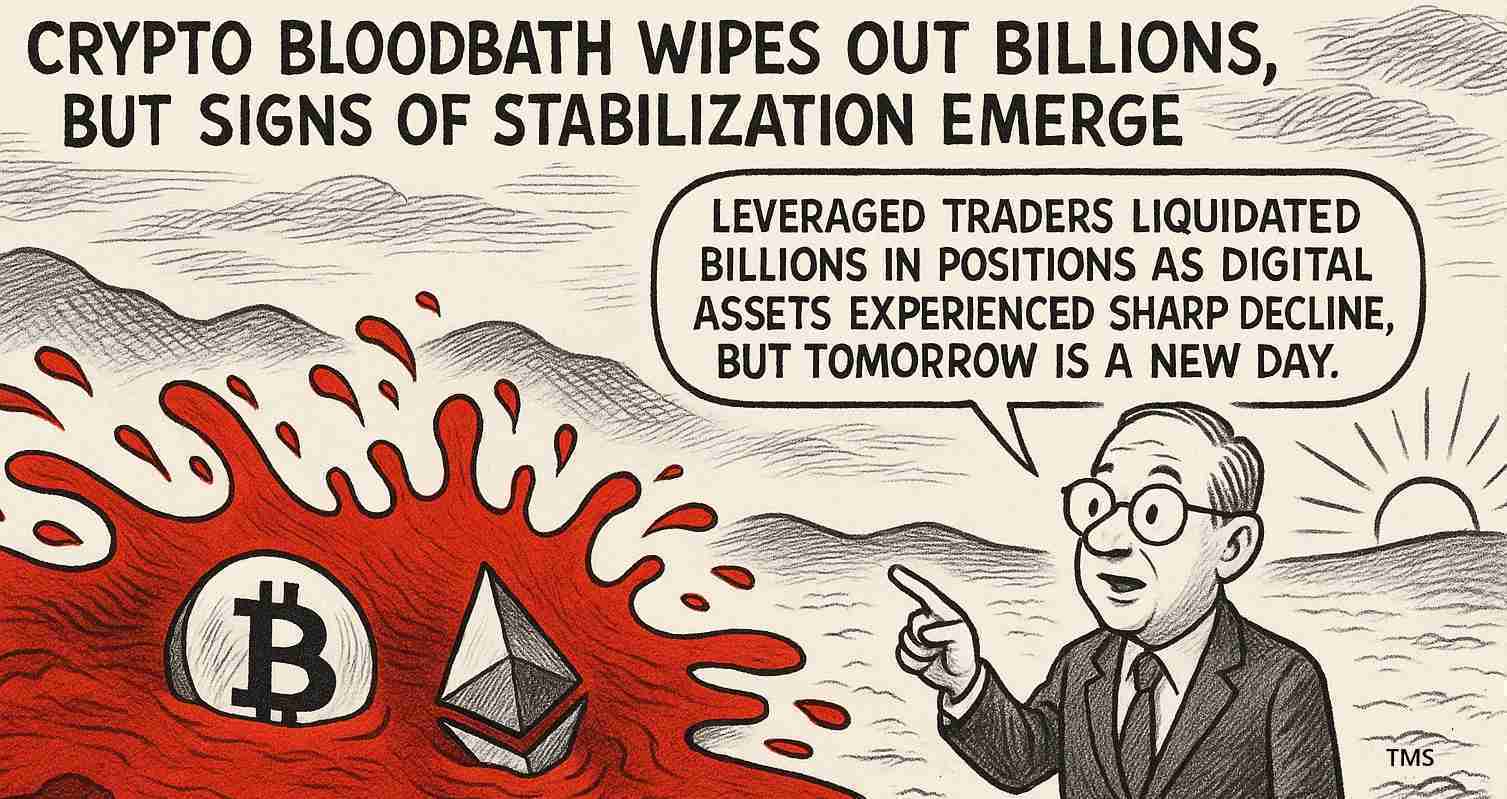
Crypto bloodbath wipes out billions as leveraged traders are liquidated — but signs of stabilization emerge
A severe crypto market crash on October 10, 2025 erased hundreds of billions — driven by leveraged liquidations and geopolitical shock from Trump’s China tariff threat. Altcoins plunged while Bitcoin showed resilience; analysts now see early signs of stabilization.
- Roughly $560 billion wiped from the market between Oct. 6–10, 2025, per Wiston Capital.
- Estimates say up to $280 billion may have been lost in a single day, with some altcoins plunging ~33%, reported by 247 Wall Street and CoinDesk.
- Approximately $18.7–19 billion of leveraged positions were liquidated, mainly impacting highly leveraged retail traders (CoinDesk; TradingView/NewsBTC; DL News).
- Market trigger: former President Trump’s threat of a 100% tariff on Chinese imports, a geopolitical shock that spooked risk assets (CoinDesk; DL News).
What happened: the crash in plain terms
On Oct. 10, prices plunged within minutes. Altcoins — tokens other than bitcoin, ether and stablecoins — fell sharply, with some losing about a third of their value in under 30 minutes before partially recovering. Across several days the market lost an estimated $560 billion from Oct. 6–10, per Wiston Capital. One-day tallies in some reports placed the hit near $280 billion (247 Wall Street).
Leverage and liquidations: a self-reinforcing spiral
A principal mechanic was leverage — traders borrowing funds to amplify positions. When prices swung violently, exchanges auto-closed losing leveraged trades (liquidations) to limit losses. That forced selling, which pushed prices down further and triggered more liquidations. Analysts estimate about $18.7–19 billion in leveraged positions were forcibly closed during the event, making it one of the largest one-day liquidation episodes in crypto history (CoinDesk; TradingView/NewsBTC; DL News).
Why bitcoin held up better
While many smaller tokens collapsed, Bitcoin exhibited relative strength. Observers say investors rotated out of higher-risk altcoins into bitcoin, which often serves as the benchmark during market stress. That rotation increased bitcoin’s market share even as total market capitalization fell (CoinDesk).
The geopolitical spark
The immediate catalyst was former President Trump’s public threat of a 100% tariff on Chinese imports. The announcement rattled global markets and hit risk assets, including crypto. Analysts note crypto had been weaker than stocks for weeks beforehand, a divergence that left the sector more vulnerable to a sharp move (CoinDesk; DL News).
Expert reads and stabilize signals
Many market pros described the move as a classic leverage-driven cascade. Charlie Erith of Wiston Capital used that framing and noted bitcoin’s market share rose because non-bitcoin tokens were hit hardest.
“A classic leverage-driven cascade — bitcoin held up as smaller tokens were forced out,”
— Charlie Erith, Wiston Capital
Traders are now watching technical indicators for early stabilization signals: bitcoin’s 365‑day exponential moving average (EMA), market dominance metrics and broader volatility measures that could signal the selloff has concluded (CoinDesk; TradingView/NewsBTC).
Bullish forecasts — and why to be cautious
Some commentators foresee a sharp rebound. Ash Crypto predicts a quick correction followed by a parabolic run into year-end, with targets as high as $150,000–$180,000 for bitcoin and $8,000–$12,000 for ethereum in Q4. Wiston Capital says it will remain invested but avoid leverage until clear technical signals return.
Risk note: Analysts warn against returning with high leverage. The crash exposed how quickly leveraged positions can be wiped out; waiting for technical stability and avoiding margin trades remains the prudent path for most retail investors (CoinDesk; TradingView/NewsBTC).
Allegations and market mechanics
Some reports questioned whether the crash represented a “coordinated hit” on large exchanges, though that theory is not universal and lacks conclusive proof (Mitrade). Most observers point to leveraged retail positions as the dominant driver and emphasize that leverage remains a systemic vulnerability in crypto markets (DL News).
Risk warnings for investors
Commentators broadly caution against re-entering the market with high leverage. The event underscored the fragility of margin positions and the speed at which liquidations can cascade. Recommended steps: review exposure, avoid margin trading until volatility subsides, and consult licensed financial advisers before making major moves.
Implications for San Luis Obispo, California
Economic impact: San Luis Obispo County hosts a small but active community of tech entrepreneurs, crypto traders and startups. Local investors with leveraged positions may face losses that reduce consumer spending at restaurants, shops and wineries. Most area banks and county pensions have limited direct crypto exposure, which caps broader fiscal risk.
Political consequences: Local officials and candidates may face questions about financial stability and investor education. Losses concentrated among younger, tech-savvy voters could surface in community forums or council meetings regarding consumer protection and literacy.
Social effects: Cal Poly students and blockchain meetup groups may see reduced participation or a shift to more conservative strategies. The crash could drive community organizations and libraries to offer plain-language finance sessions on margin and leverage risks.
Cultural relevance: A fall in local personal wealth can affect discretionary spending on dining, wine tourism and boutique retail. Conversely, a measured rebound in Bitcoin and Ethereum could renew interest in blockchain projects for supply chains, arts and small-business payments.
Practical steps for residents
- Review personal exposure and holdings; prioritize capital preservation.
- Avoid trading on margin or using leverage until markets calm.
- Merchants accepting crypto should consider pricing in dollars or using immediate conversion tools.
- Community groups and schools can expand plain‑language financial education focused on leverage and margin risks.
Sources and further reading
- CoinDesk: Altcoins cratered in Oct. 10 crypto flash crash as bitcoin held up, Wiston Capital says
- TradingView/NewsBTC: Crypto crash prediction comes true: Here’s what’s next for Bitcoin and Ethereum
- DL News: Leverage and China tariffs drive $19bn crypto crash
- 247 Wall Street: Cryptos’ $200 Billion Crash — Can Bitcoin Hope to Recover?
- Mitrade: Live news coverage on Oct. 12 crypto market moves
Reporting compiled by Times Media Service. Relevant market data and expert commentary are cited above.