Trump orders 100% additional tariff on Chinese imports starting Nov. 1, citing rare earth export controls
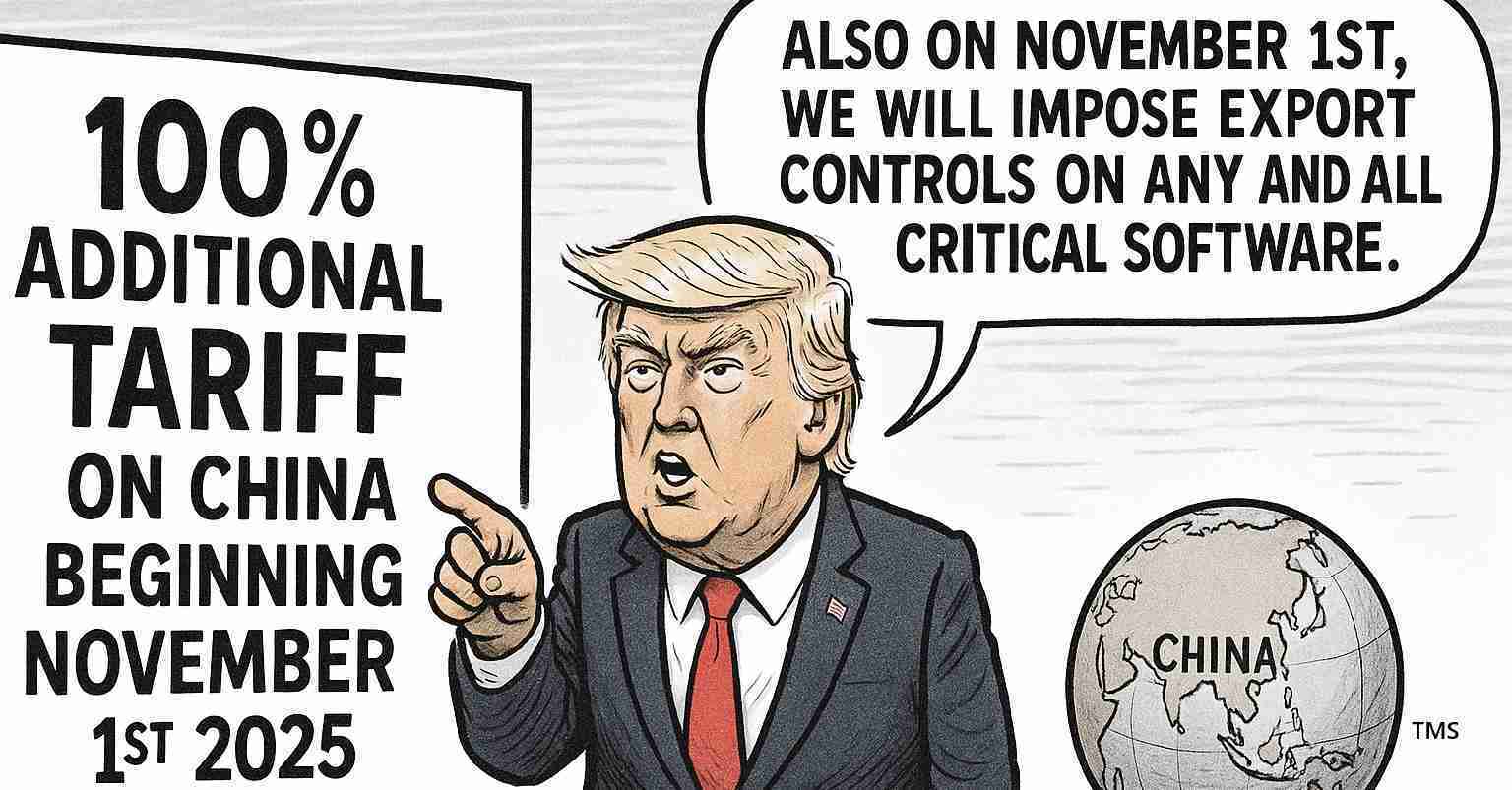
Former President Donald Trump ordered a 100% additional tariff on all Chinese imports effective Nov. 1, 2025, citing China’s expanded rare-earth export controls — a step that could sharply raise consumer costs and disrupt global supply chains.
- What: A 100% additional tariff on all imports from China, added on top of existing duties. (CBS News)
- When: Scheduled to take effect Nov. 1, 2025; the administration said the measure could come sooner if China takes further steps. (CBS News)
- Why: A response to China’s expanded export controls on rare earth minerals, which the U.S. says threaten supply chains for critical industries. (Economic Times)
- Also: New U.S. export controls on “any and all critical software” begin the same date. (CBS News)
What the announcement says
Trump announced on national media that the United States will place an extra 100% tariff on every item imported from China, starting Nov. 1, 2025. The new levy is in addition to tariffs already in place — which officials estimate average roughly 30% on many goods — and was described as necessary to protect American industry and national security. (CBS News)
The White House also announced expanded export controls, banning shipment of “any and all critical software” to China as of the same date. Officials framed the steps as both punitive and preventive: intended to pressure Beijing while limiting the flow of sensitive technology. (CBS News)
Why rare earth export controls triggered this
China recently widened rules requiring special approvals for products containing even trace amounts of rare earth minerals. Beijing added five elements — holmium, erbium, thulium, europium and ytterbium — to a restricted list, bringing the count to 12 of the 17 elements typically considered critical. These materials are used in consumer electronics, electric vehicles, semiconductors and defense systems. (Economic Times)
China’s Commerce Ministry: The restrictions safeguard national security and aim to prevent rare earths from being used in military or sensitive technologies.
U.S. officials said the move is an attempt to weaponize supply chains — prompting the tariff decision. (Economic Times)
How this escalates the US-China trade war
Analysts call the order a major escalation. Earlier tariffs targeted specific sectors; a blanket extra 100% charge across all imports is far broader and could sharply raise prices for everyday goods and for components used by U.S. factories. (CBS News)
Risks include:
- Slower trade and disrupted supply chains.
- Higher costs for manufacturers that depend on Chinese components.
- Ripple effects across electronics, automotive and clean-energy industries. (Economic Times)
Possible Chinese responses
At the time of the announcement, Beijing had not issued a formal countermeasure. Trade experts expect potential retaliation such as reciprocal tariffs, further export controls, or limits on purchases of U.S. goods. Any response could deepen the confrontation and affect global markets. (video briefing)
Diplomatic consequences
Trump warned the tariff move could affect scheduled diplomacy, including a potential summit with Chinese President Xi Jinping and future participation in multilateral gatherings like APEC. Those threats increase uncertainty about high-level talks traditionally used to manage tensions. (The Journal; video)
Market and supply-chain impact
Markets typically react swiftly to trade shocks. Investors and companies will be watching price moves in sectors tied to China. Businesses sourcing parts from China may face higher input costs and longer lead times; industries that rely on rare earths could be especially strained since alternatives are limited.
Short-term effects may include price spikes, inventory hoarding and disrupted production schedules. Over the medium term, firms may accelerate supply-chain diversification — at cost. (CBS News; Economic Times)
Voices and analysis
Commentators and trade experts: Many called the move “massive” and pivotal. Some argue it protects national security and encourages supply-chain diversification; others say broad tariffs risk harming U.S. manufacturers and consumers by raising costs and slowing growth. Coverage and analysis are ongoing. (CBS News; Economic Times; The Journal)
Sources and further reporting
- CBS News: Trump announces 100% additional tariff on China
- Economic Times: Details on tariff and rare earth export controls
- The Journal: Coverage of diplomatic implications
- Video briefings and live reports (examples): video briefing — YouTube, video — YouTube, video — YouTube
Implications for San Luis Obispo, California
Economic ripple effects are likely to reach regional economies, including San Luis Obispo County. Local officials, business owners and residents should consider several practical impacts:
- Consumer prices and household budgets: Retail prices on electronics, clothing, home goods and other imports could rise, squeezing household budgets.
- Local manufacturers and suppliers: Companies using Chinese parts may face higher input costs, tighter margins, or the need to find new suppliers.
- Agriculture and equipment: Farms and vineyards relying on imported machinery, irrigation parts or chemicals may see higher operating costs.
- Clean energy and EV infrastructure: EV components and chargers that use rare-earth elements or Chinese-made parts could become costlier, slowing local adoption.
- Jobs and small businesses: Higher costs could pressure hiring and small-business revenues if production is cut or delayed.
- Supply-chain disruptions: Delivery delays and shortages could hit small firms that lack flexibility.
- Government and policy response: Local governments may need to offer guidance, connect businesses with alternative suppliers, or seek state and federal assistance.
What local leaders and residents can do now
- Inventory and planning: Audit supply chains to identify reliance on Chinese inputs and begin sourcing alternatives.
- Cost management: Review contracts, pricing strategies and short-term cost controls to weather initial shocks.
- Seek assistance: Contact San Luis Obispo economic development offices and trade groups for resources, grants and supplier connections.
- Monitor developments: The tariff order could change based on China’s actions or court challenges; follow credible national reporting and official guidance. (CBS News; Economic Times)
Bottom line
The move marks a sharp turn in the U.S.-China trade war and injects fresh uncertainty into global supply chains and local economies alike. Journalists and analysts will watch policy changes, market responses and any Chinese countermeasures closely in the coming weeks. (CBS News; Economic Times; The Journal)