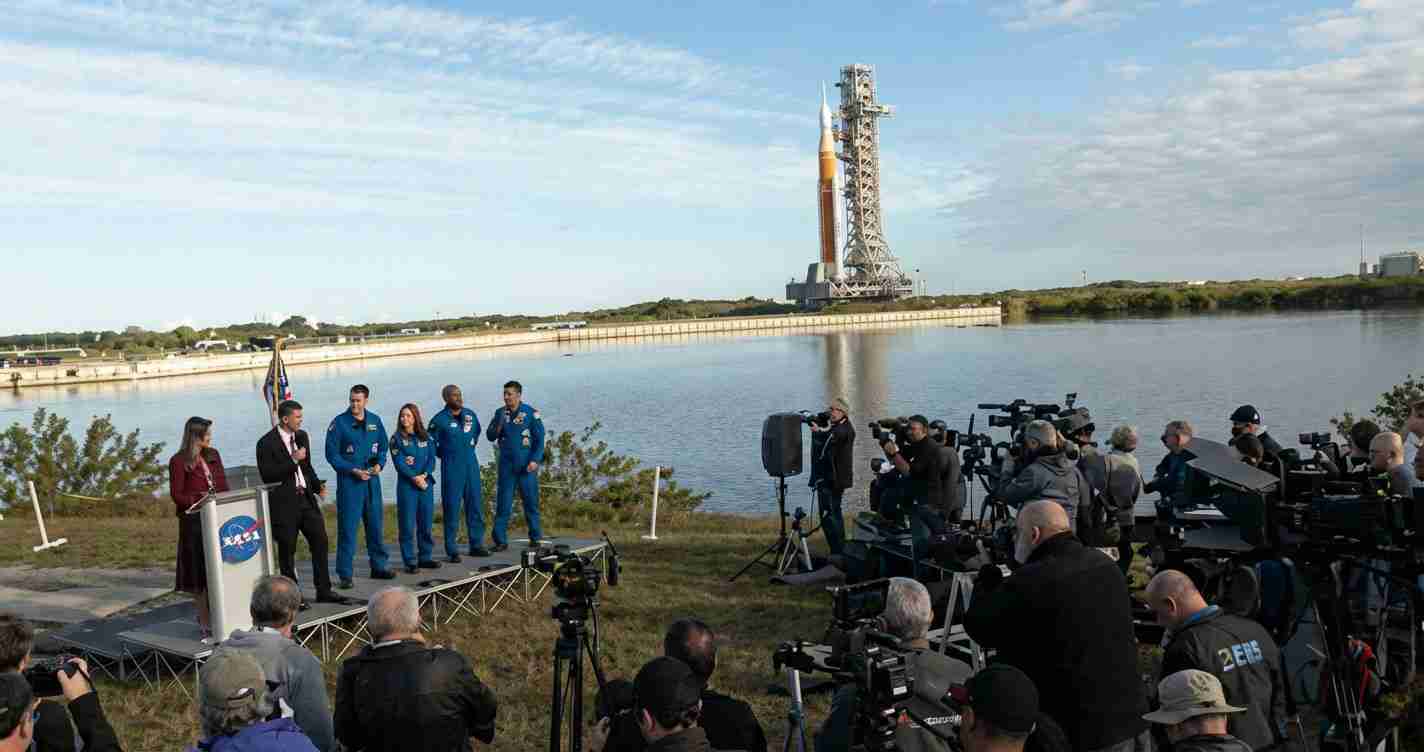
Artemis II rocket, Orion capsule complete slow crawl to Pad 39B as NASA moves toward crewed lunar flight
The Artemis II Space Launch System and Orion spacecraft completed a slow rollout to Launch Complex 39B at Kennedy Space Center on Jan. 17, 2026, marking a key step toward a planned crewed lunar flyby targeted for Feb. 6, 2026.
Key takeaways
- Long, deliberate rollout: The vehicle moved nearly seven kilometers over ~11.5 hours on crawler-transporter-2 — a careful process to protect systems and inspect hardware (Artemis II rollout coverage).
- Mission profile: Artemis II is a 10-day crewed lunar flyby carrying Reid Wiseman, Victor Glover, Christina Koch and Jeremy Hansen; it will not enter lunar orbit (NASA mission details).
- Next milestone: A full wet dress rehearsal is scheduled for Feb. 2; success there is a gating item for the Feb. 6 launch window (NASA final steps update).
Rollout and why it matters
What happened: NASA rolled the fully stacked Artemis II vehicle and Orion capsule from the Vehicle Assembly Building to Launch Complex 39B on Jan. 17. The move signals the start of final pad work: hookups to ground systems, final tests and rehearsal runs that mimic the countdown and launch day sequence.
How it was done: The 322-foot-tall Space Launch System rode the historic Mobile Launch Platform on crawler-transporter-2 at under one mile per hour along a crawlerway bedded with river rock. The slow pace and scheduled stops allow engineers to inspect delicate systems; short holds for troubleshooting during the trek are normal (live rollout coverage, detailed timeline).
“The rollout checked a big box but did not eliminate risk.” Pad integration and final hookups often reveal issues that require time to resolve.
Rollout details and technical notes
Vehicle and transport: The SLS for Artemis II stands about 322 feet tall and traveled on a Mobile Launch Platform atop crawler-transporter-2 — a lineage shared with Apollo-era carriers but updated for modern hardware. Planned retractions (like the crew access arm) and brief troubleshooting stops occurred during the move; such holds give teams time to inspect systems and confirm readiness (Artemis II rollout coverage).
Timeline and coordination: The nearly seven-kilometer move began at 7:04 a.m. EST and finished at 6:42 p.m. EST, with teams working before and after the rollout to close out vehicle tasks and begin pad integrations. The pad environment ties vehicle, ground systems, safety systems and launch control together; any late discovery can change the schedule (operations commentary).
Mission profile and crew
Flight plan: Artemis II is planned as a 10-day crewed lunar flyby that will not enter lunar orbit. Orion will carry the crew roughly 7,500 kilometers beyond the lunar far side before returning, testing life support, communications, navigation and crewed operations in deep space (mission reporting, NASA mission page).
Crew: Commander Reid Wiseman leads the four-person team, with Pilot Victor Glover and mission specialists Christina Koch and Jeremy Hansen. Hansen will be the first Canadian on a deep-space Artemis mission. The crew will run systems checks, exercise Orion’s capabilities and validate procedures that support future lunar surface missions (Artemis II overview).
Wet dress rehearsal and the launch window
A full wet dress rehearsal is scheduled for Feb. 2. Teams will perform a complete countdown and load propellant into the rocket, stopping short of engine ignition. The test verifies fueling systems, propellant lines and end-to-end launch operations. Success is a major gating item for the Feb. 6 launch target; the launch window extends through April 2026 (rollout analysis, NASA final steps).
Investigative view: schedule risks and readiness
Remaining risks: The rollout verifies transport and arrival, but pad integration can surface new issues not seen in the Vehicle Assembly Building. Florida weather (rain, lightning, high winds), hardware aging and supply-chain constraints are all potential schedule drivers.
NASA has emphasized that Feb. 6 is conditional: the date is tied to the wet dress rehearsal and the absence of major technical discoveries. Observers will watch rehearsal results and closure times for fixes and workarounds (official NASA update).
Implications for San Luis Obispo, California
Economic impact
San Luis Obispo will not receive direct launch revenue, but the national space economy’s activity can influence local education and workforce trends. Cal Poly San Luis Obispo and regional trade programs could see increased enrollment and demand for aerospace-related internships, research projects and industry partnerships (NASA mission page).
Political consequences
A successful Artemis II could boost public visibility for federal space spending and provide momentum for local leaders advocating workforce development and STEM funding. Conversely, costly delays could reframe local and national debates about program costs and oversight (NASA final steps update).
Social effects
The mission offers a teaching moment: schools, libraries and museums can coordinate programming around physics, orbital mechanics and human spaceflight history. Local watch events and community screenings could spark interest in STEM careers among young residents (mission information).
Cultural relevance
Artemis II evokes the Apollo narrative of exploration. Regional cultural institutions might host exhibits linking the mission to local engineering history and national spaceflight heritage, reinforcing public visibility for science and engineering careers.
Practical applications
Residents can engage remotely: universities and libraries can stream NASA briefings, students can use telemetry and mission data for projects, and workforce programs can develop targeted training, certificates and partnerships with community colleges to prepare talent for aerospace supply chains (NASA mission details).
What to watch next
Key dates: Feb. 2 wet dress rehearsal and NASA’s subsequent announcements about the Feb. 6 target launch. Whether the rehearsal succeeds or reveals issues, local leaders and educators should prepare programming and communications that leverage the mission’s outcomes for workforce and STEM outreach (detailed rollout and timeline, live operations coverage).
Sources and further reading
- Artemis II rollout coverage and timeline
- Live coverage and commentary on rollout and operations
- NASA final steps update for Artemis II
- Mission details from NASA
- Artemis II overview (Wikipedia)
Reporting note: This article preserves original factual reporting and the sources cited above for readers who want primary coverage and technical timeline details.