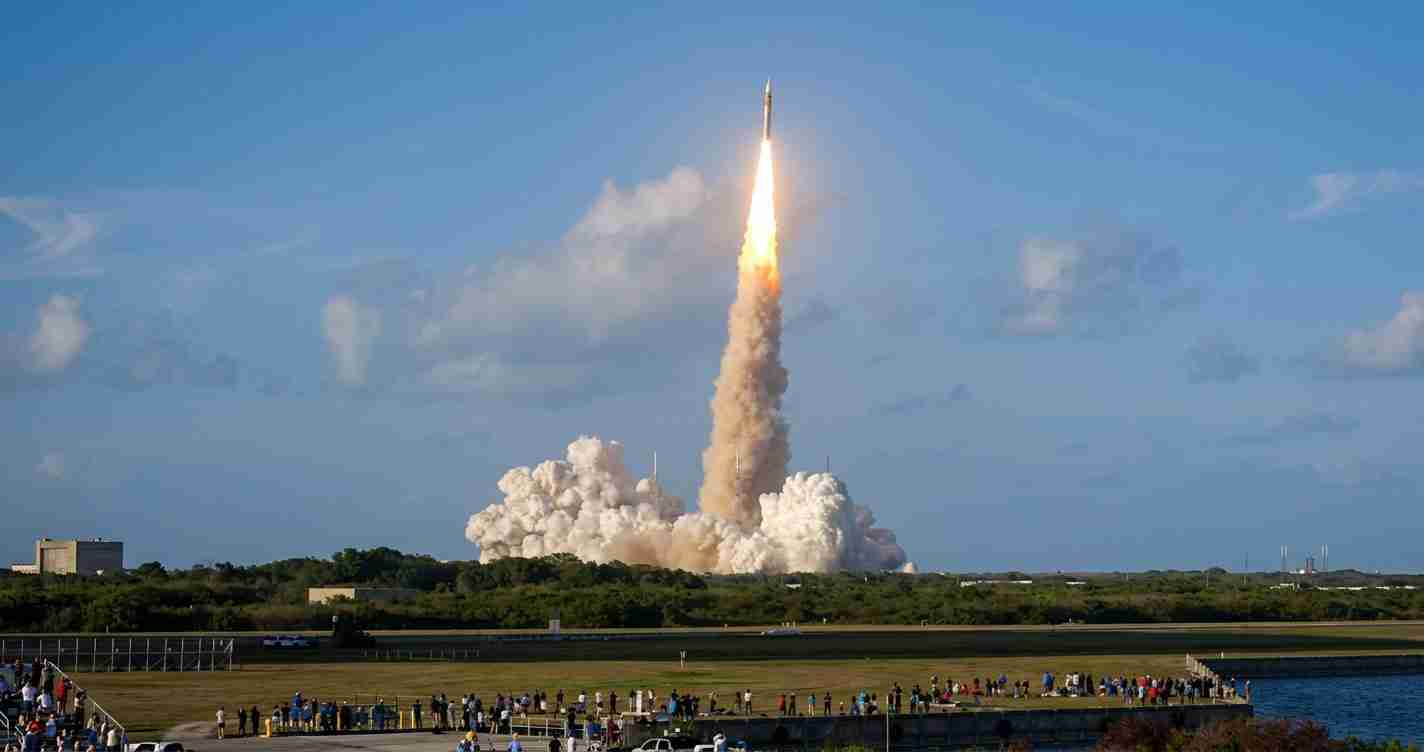
Artemis II launches first crewed deep‑space mission since 1972, begins 10‑day lunar flyby
NASA’s Artemis II launched April 1, 2026, from Kennedy Space Center, sending four astronauts on a roughly 10‑day lunar flyby — the first crewed deep‑space flight since 1972 and a critical test of SLS and Orion systems.
Key takeaways
- Historic flight: First crewed deep‑space mission since 1972, a 10‑day free‑return lunar flyby.
- Crew and partners: Commander Reid Wiseman, Pilot Victor Glover, Mission Specialists Christina Koch and Jeremy Hansen (Canadian Space Agency).
- Primary objective: Validate the Space Launch System (SLS) and Orion deep‑space systems in crewed flight for Artemis IV and V.
- Public tracking: Real‑time mission data and updates available from NASA and Kennedy Space Center sources.
Launch, ascent and early orbit
Where and when: The Space Launch System (SLS) heavy‑lift rocket launched from Kennedy Space Center, Launch Complex 39B, Florida, with liftoff at 6:35 p.m. EDT on April 1, 2026. The countdown began at 4:44 p.m. EDT.
The SLS reached supersonic speed and completed core stage separation roughly eight minutes after liftoff, placing the Orion spacecraft and crew into high Earth orbit atop the interim cryogenic propulsion stage. Mission teams reported that Orion’s solar array wings (SAWs) deployed successfully after orbit insertion. Crewmembers spent the next day performing system checks while engineers reviewed telemetry; if all systems are nominal, Orion will depart Earth orbit on mission day two for the translunar leg (see NASA live updates).
Flight path, timeline and objectives
Artemis II follows a free‑return trajectory that will carry the Orion crew around the far side of the Moon and back to Earth in about 10 days. The spacecraft should reach lunar vicinity in roughly three days and will pass closest to the lunar surface on mission day six at an altitude near 8,000 kilometers, the point at which the crew will be farthest from Earth and may witness a brief solar eclipse as Orion swings behind the Moon (details in NASA live updates).
The mission’s chief aim is not a landing but to demonstrate and validate SLS and Orion deep‑space systems in crewed flight. Data from Artemis II will inform hardware and procedures for Artemis IV and V, which are planned to return humans to the lunar surface as soon as 2028 (see the Kennedy Space Center event page).
Crew, milestones and teamwork
The four‑person crew blends experience and program milestones: Commander Reid Wiseman, Pilot Victor Glover, and Mission Specialists Christina Koch (NASA) and Jeremy Hansen (Canadian Space Agency). Wiseman spoke from Orion shortly after launch:
“We have a beautiful moonrise; we’re headed right at it.”
Notable firsts: Victor Glover is the first person of color and Christina Koch the first woman to travel beyond low Earth orbit on this mission. Canadian partner Jeremy Hansen underscores the multinational cooperation central to Artemis (see Kennedy Space Center event page and NASA live updates).
Observers and planetary scientists called the launch a defining moment. Paul Byrne described it as a “historic moment,” while Lindy Elkins‑Tanton praised the crew’s cohesion and the way teamwork “fades into the background” across differences (analysis and commentary available via the Planetary Society and NASA media coverage).
Pre‑launch delays and checks
Artemis II’s schedule included multiple delays and technical checks. The mission was originally targeted for early February but was pushed back after teams encountered hydrogen fuel leaks and a helium flow issue in the rocket’s upper stage. Weather and high winds affected rollout to Launch Pad 39B in mid‑March, and final countdown holds shifted the target from 6:24 p.m. to 6:35 p.m. Flight Readiness Reviews in March cleared the mission for the April launch window after engineers resolved those concerns (NASA live updates; summary at Wikipedia).
How to follow the mission
NASA provides real‑time tracking and telemetry. The public can follow Artemis II through the Artemis Real‑time Orbit Website and the official NASA mobile app; NASA’s live blog and social channels post updates and imagery as the flight proceeds. For mission narrative and live commentary, see NASA live updates and the Kennedy Space Center event page.
Sources and reporting
This article draws on NASA’s live mission updates and briefings, Kennedy Space Center materials, and analysis from space research outlets. Key sources include NASA’s mission blog, the Kennedy Space Center event page, the Planetary Society overview and a summary at Wikipedia.
Implications for San Luis Obispo, California
The Artemis II mission has local implications for the San Luis Obispo region across economic, political, social and cultural dimensions. Below are practical ways the community may be affected and can engage.
Economic impact
- Local tech and aerospace firms: San Luis Obispo County hosts small aerospace suppliers and engineering firms that may benefit from increased federal lunar program spending through subcontracts and research grants.
- Tourism and events: High‑profile missions often spur astronomy events, museum nights and school programs; local hotels and restaurants could see small boosts tied to public viewing events.
Political consequences
- Funding conversations: Success on Artemis II could motivate local and state leaders to pursue grants and investments in STEM education and infrastructure at community colleges and Cal Poly San Luis Obispo.
- Regional representation: Local officials may press for stronger representation in contract and grant competitions as federal space spending increases.
Social effects
- Education and youth engagement: Schools, libraries and after‑school programs are likely to organize watch parties, curriculum units and hands‑on STEM activities tied to Artemis II.
- Community pride and inclusivity: The diverse Artemis II crew provides teachable moments about teamwork and inclusion that local organizations can leverage.
Cultural relevance
- Public interest in space: The Moon resonates with Central Coast culture — moonrises, public talks and observatory viewings create shared moments.
- Media and arts: Local artists and storytellers may draw inspiration from mission imagery and themes for exhibits and community projects.
Practical applications for residents
- Viewing and tracking: Residents can track the flight via NASA resources; local observatories and planetariums often host viewing events for launch highlights and flyby milestones.
- Education resources: Teachers and parents can use NASA educational materials tied to the Artemis program for lesson plans and hands‑on activities.
- Local planning: City and county cultural affairs offices may coordinate public events; community members can contact local libraries, the San Luis Obispo County Office of Education or Cal Poly departments to propose watch parties or outreach.
Reporting note: Coverage for this story relied on live updates and briefings from NASA’s Artemis blog, the Kennedy Space Center event page, and analyses such as the Planetary Society overview and related summaries (Wikipedia).