6-million-year-old ice discovered in Antarctica offers unprecedented climate window — and ancient air trapped inside
Researchers in East Antarctica recovered the oldest directly dated ice and trapped air ever found — about six million years old — in the Allan Hills, opening an unprecedented window into ancient climate, temperature change and past greenhouse-gas levels.
- Oldest directly dated ice: Woods Hole Oceanographic Institution press release reports COLDEX recovered ~6-million-year-old ice and trapped air in the Allan Hills.
- Direct dating method: Scientists dated an argon isotope trapped in air bubbles, giving a proven age rather than relying on layer matching (Maine Climate Change coverage).
- Climate signal: Oxygen isotope measurements suggest roughly a 12°C (≈22°F) cooling in East Antarctica over the last 6 million years, and trapped air offers potential direct greenhouse-gas measurements (PNAS article).
How the discovery was made
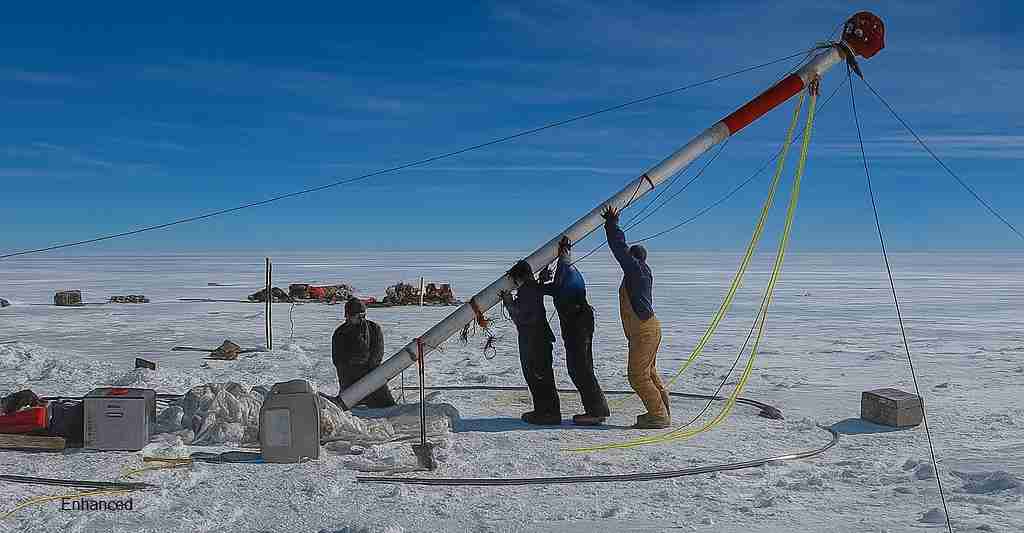
Targeting the Allan Hills, researchers from multiple U.S. institutions led by Oregon State University, the Woods Hole Oceanographic Institution and Princeton University worked under the Center for Oldest Ice Exploration (COLDEX). They selected Allan Hills because local ice-sheet flow and erosion expose very old ice at or near the surface, making ancient layers accessible for sampling.
Field teams recovered cores and surface samples containing sealed air bubbles. In the laboratory they performed a direct dating measurement by analyzing an argon isotope trapped in the bubbles — a method that yields a verified age for the ice rather than relying on indirect correlations to nearby cores or geological markers.
“Direct dating of trapped air is rare for very old ice; this measurement is why researchers call it the oldest directly dated ice and trapped air discovered so far.”
What the ice and air reveal about Earth’s climate history
The cores contain both oxygen isotopes in the ice and sealed air pockets that act as time capsules. Oxygen isotope ratios reconstruct a temperature record for East Antarctica; those data indicate a long-term cooling trend of roughly 12°C (≈22°F) across the last 6 million years (Maine Climate Change; PNAS).
The trapped air preserves atmospheric composition at the time the snow turned to ice. If greenhouse gases such as carbon dioxide can be extracted and measured precisely from these ~6 Ma bubbles, researchers will obtain paired temperature and greenhouse-gas records from the same samples — a long-standing goal for paleoclimate science when studying warm epochs like parts of the Miocene and Pliocene.
Paired records provide a crucial test of climate drivers and feedbacks active during warmer Earth states.
Why this matters now
Most Antarctic ice-core records previously extended back a few hundred thousand to about 1.5 million years and come from deep, cold interior sites. The Allan Hills discovery extends that window by millions of years into times with substantially higher global temperatures and sea levels. These longer records can help:
- Test and validate climate models used to predict future warming and sea-level rise.
- Clarify natural variability and long-term feedbacks that amplify warming or cooling.
- Provide direct empirical comparisons of greenhouse-gas concentrations and regional temperature change (PNAS study).
Research team and next steps
COLDEX coordinated the effort, bringing together U.S. scientists from Oregon State University, WHOI, Princeton University and other institutions. Following the initial analyses, COLDEX plans an expanded drilling campaign between 2026 and 2031 to recover longer, more continuous ice records and extract additional trapped air for greenhouse-gas measurements.
Visual summaries and project overviews are available from participating institutions; see the visual summary and short video overview for a concise project primer.
Uncertainties and limits
Although the find is a major advance, ancient surface-exposed ice can be fragmented, mixed, or altered by local flow and melt processes, making continuity and interpretation challenging. Researchers emphasize careful sorting, repeated sampling, and combined dating methods to confirm robust age and composition records.
Extracting greenhouse gases from extremely old ice requires highly sensitive laboratory techniques and cross-checks. The next phase will focus on improving measurement precision and confirming that trapped air truly represents atmospheric conditions when the ice formed (PNAS).
Implications for San Luis Obispo, California
Economic impact: San Luis Obispo County—dependent on tourism, vineyards and agriculture—can use refined paleoclimate data to improve risk assessments for sea-level rise and coastal flooding. Better forecasts could influence infrastructure investments, beachfront policy and insurance planning.
Political consequences: The Allan Hills findings add long-term context to climate discussions and may help local policymakers justify updated zoning, coastal protections and emergency budgets based on evidence-based scenarios rather than partisan framing.
Social and cultural effects: Residents and businesses will watch for implications on water availability, growing seasons and storm patterns. The discovery reinforces the need for resilience planning—water conservation, shoreline stabilization and community education—aligned with San Luis Obispo’s outdoor and agricultural values.
Practical applications include revising flood maps, adjusting coastal-road elevation standards, updating water-management strategies for the Paso Robles and San Luis Obispo basins, and using the discovery as an educational tool in local schools and universities.
Sources and further reading
- Woods Hole Oceanographic Institution news release: “Six-million-year-old ice discovered in Antarctica offers unprecedented window into a warmer Earth”
- University of Maine climate coverage: “Ice core analysis reveals cooling period 6m years ago”
- Proceedings of the National Academy of Sciences research article
- Visual summary and short video overview
Summary: The Allan Hills ice core opens a direct path to study Miocene and Pliocene climates, linking ancient temperatures with atmospheric composition. As COLDEX prepares multi-year campaigns starting in 2026, coastal communities and scientists will monitor new data that refine projections for sea-level rise and long-term climate change.