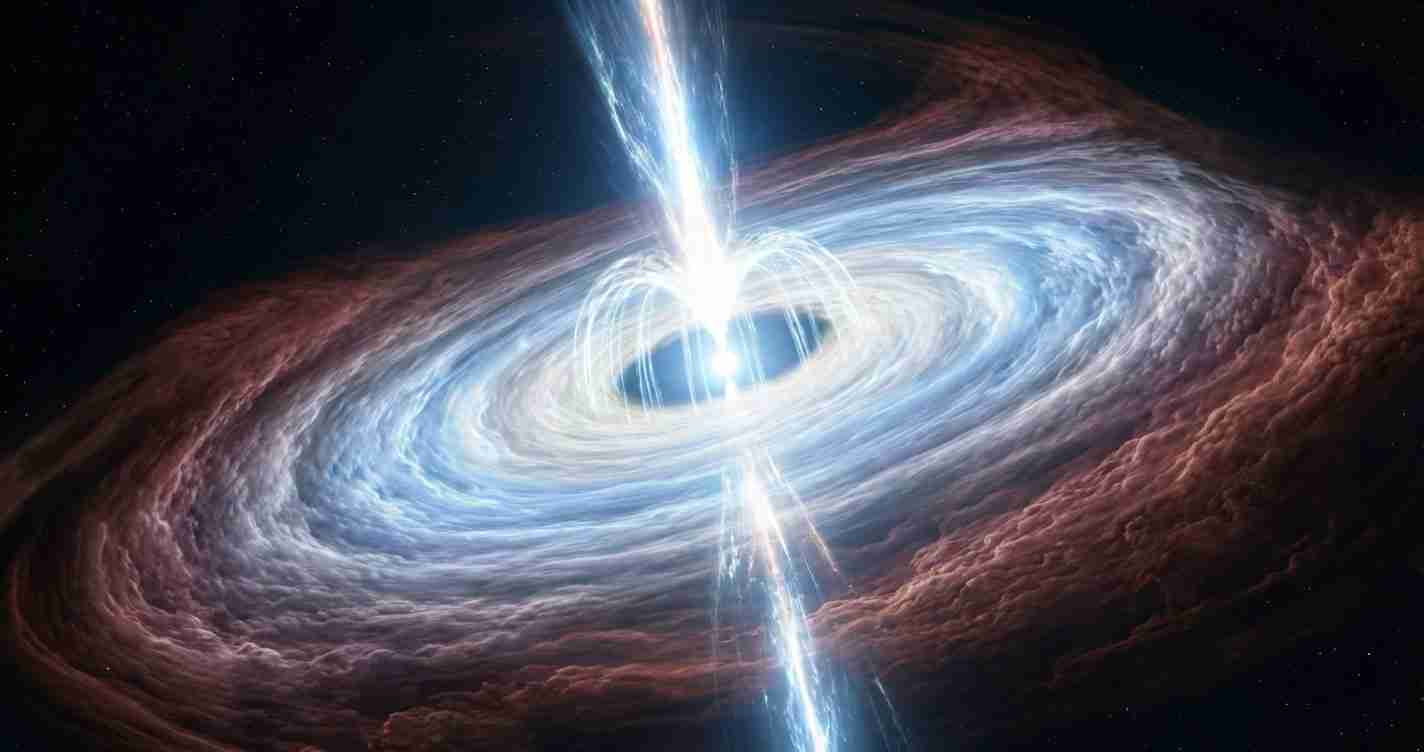
Astronomers Witness Magnetar Birth That Powers Superluminous Supernova, Reveal General Relativity “Chirp”
Astronomers have made a groundbreaking observation, witnessing the birth of a magnetar—a highly magnetized neutron star—for the first time within the supernova SN 2024afav, confirming magnetars power some superluminous supernovae and revealing a relativistic “chirp.”
Key takeaways
- First direct observation: The newborn magnetar was identified inside SN 2024afav (eruption: December 2024), linking magnetars to some Type I superluminous supernovae (SLSN-I).
- Relativistic “chirp”: Small, periodic bumps in the light curve match models that include general relativity, strengthening the magnetar-powered interpretation.
- Magnetar properties: Modeling yields an initial spin of ~4.2 milliseconds and a magnetic field ~300 trillion times Earth’s.
- Implications: The discovery provides a tool to identify magnetar-driven explosions and may connect magnetars to other extreme phenomena like FRBs.
Key information
Event: Observation of a magnetar forming inside supernova SN 2024afav, first seen in late 2024 (eruption: December 2024). The research was published in Nature on March 11, 2026 and reported by multiple institutions.
Distance & type: The explosion lies about 1 billion light-years away and is classified as a Type I superluminous supernova (SLSN-I).
Magnetar characteristics: Best-fit models give an initial spin near 4.2 milliseconds and a magnetic field roughly 300 trillion times that of Earth.
How the magnetar model explains superluminous supernovae
Superluminous supernovae shine far brighter and longer than ordinary supernovae, a puzzle since their discovery in the early 2000s. In 2010 UC Berkeley theorist Dan Kasen and colleagues proposed that some very bright supernovae are powered by newborn magnetars—rapidly spinning, extremely magnetic neutron stars.
When a massive star (about 25 times the mass of the Sun in this case) collapses, its core compresses into a neutron star roughly 10 miles across. If the core carries a very strong magnetic field, the collapse amplifies it into a magnetar with spin periods measured in milliseconds and fields hundreds to thousands of times stronger than typical pulsars.
Energy input: A fast-spinning magnetar loses rotational energy as it slows (spin-down). That energy heats the expanding debris from the explosion; the heated debris then emits light far longer and brighter than it would from radioactive decay alone—this is the essence of the magnetar-powered SLSN model.
The “chirp” and general relativity
The teams detected small, regular bumps in the supernova’s light curve that form a rising-and-falling pattern researchers call a “chirp.” These bumps match predictions made when a magnetar’s intense gravity and rapid rotation interact with the surrounding expanding shell of debris. Those interactions require effects described by Einstein’s general theory of relativity.
“To see a clear effect of Einstein’s general theory of relativity is always exciting, but seeing it for the first time in a supernova is especially rewarding,” — Alex Filippenko, UC Berkeley.
The chirp functions as a smoking gun: it ties the light-curve bumps directly to a spinning magnetar and fits models that include relativistic effects, strengthening confidence that magnetars power at least some SLSNe.
Who led the work
The analysis was led by Joseph Farah, a UC Santa Barbara graduate student and Las Cumbres Observatory researcher who will join UC Berkeley as a Miller Postdoctoral Fellow. Key collaborators include UC Berkeley’s Alex Filippenko; Dan Kasen (whose 2010 theory predicted magnetar-powered SLSNe); Lars Bildsten; Stanford’s Woosley; and others including Logan Prust (Flatiron Institute) and Yuan Qi Ni (UCSB).
On being part of the discovery, Joseph Farah said:
“It’s the universe telling us out loud and in our face that we don’t fully understand it yet.”
Data and methods
SN 2024afav was first seen in late 2024. Follow-up observations came from ground-based telescopes, including the Las Cumbres Observatory network, tracking brightness over weeks and months. Scientists fit the light curve using models that incorporate magnetar spin-down and relativistic interactions; the fits produced estimates of spin (~4.2 ms) and magnetic field (~300 trillion × Earth).
Why this matters
This finding answers a long-standing mystery about some of the brightest explosions in the universe, giving astronomers a way to identify magnetar-powered events by their chirp. It also strengthens theoretical work (notably Dan Kasen’s 2010 model) and helps link magnetar formation to other extreme phenomena such as fast radio bursts (FRBs).
Implications for San Luis Obispo, California
Economic impact: Local technology and tourism businesses may see modest benefits. County suppliers and tech firms that support regional observatories, university research, and outreach could gain from increased grant funding and partnerships.
Political consequences: Officials in San Luis Obispo may cite this discovery when advocating for STEM funding at county and state levels—supporting bipartisan discussions over research budgets and university support.
Social effects: Residents can expect more public astronomy events, lectures, and school programs. The discovery may inspire students at San Luis Obispo High School, Cal Poly San Luis Obispo, and local community colleges toward STEM careers.
Cultural relevance: The story connects to a Bay Area tradition of scientific discovery. Public talks, planetarium shows, and museum exhibits about magnetars and SLSNe are likely to resonate locally.
Practical applications for residents: While daily life won’t change, education and workforce opportunities may expand—more internships, higher enrollment in STEM courses, and increased attendance at science events.
Next steps for scientists and the region
Researchers will search for more chirps in other supernovae to identify additional magnetar-powered events and refine models of magnetar formation and interaction with surrounding material. California institutions and San Luis Obispo-area researchers and students may find collaborative projects, internships, and outreach roles tied to ongoing surveys and telescope networks.
Sources and further reading
- UC Berkeley News: Astronomers capture birth of a magnetar, confirming link to some of universe’s brightest exploding stars
- Lawrence Hall of Science (UC Berkeley): Astronomers capture birth of magnetar
- National Today: Astronomers witness magnetar birth for first time
- Smithsonian Magazine: Astronomers witnessed the birth of a magnetar for the first time
Researchers say this finding offers a new way to spot magnetar-driven explosions and provides a fresh template for studying extreme physics. Observatories and universities will continue monitoring the skies; local universities and science groups in San Luis Obispo are well positioned to translate the discovery into public programs.