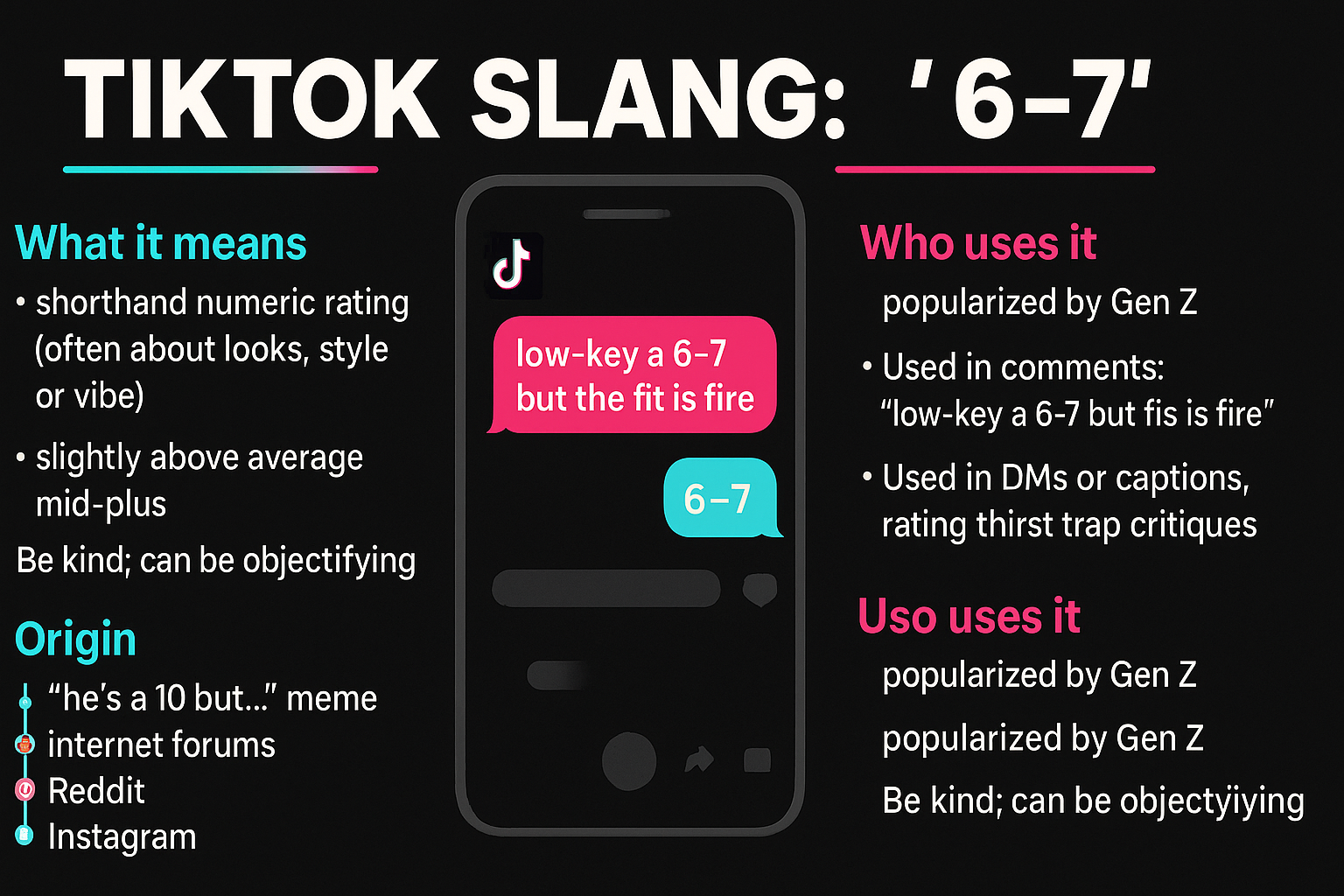
What “6-7” Means: How a TikTok Sound, a Viral AAU Clip and Gen Z Humor Turned a Number Into a Meme
The viral “6-7” meme, born from Skrilla’s 2025 track “Doot Doot (6 7)” and a viral AAU clip, became a Gen Z/Gen Alpha in-joke — an ironic exclamation, gesture and edit tag spreading across TikTok, schools and sports events.
Key takeaways
- What it is: A short shouted or sung phrase used as an ironic or awkward reaction, often paired with a small alternating-palm gesture.
- Origin: Comes from Skrilla’s song “Doot Doot (6 7)” and was amplified by a viral AAU “6-7 Kid” clip and basketball highlight edits.
- Where it spreads: Popular among Gen Z and Gen Alpha on TikTok, Instagram Reels, and in school or youth sports settings.
- Context matters: Mostly harmless in-group humor, though tone and impact depend on setting and intent.
Key information — 6-7 meme meaning explained
What it is: “6-7” is a short, often shouted or sung phrase used as an ironic or awkward reaction. It is usually delivered loudly, sometimes with a small hand gesture, and is repeated as a punchline or in-joke among young people. (Source: Wikipedia: 6-7 (meme); Parade: What does 6-7 mean?)
Where it started: The sound clip comes from Skrilla’s song “Doot Doot (6 7),” which circulated unofficially in late 2024 and was officially released in early 2025. The audio was later paired with basketball highlight videos and short clips on TikTok and Instagram Reels, which helped the phrase spread. (Source: Wikipedia: 6-7 (meme); Parade: What does 6-7 mean?)
Viral moment: A March 2025 video — commonly called the “6-7 Kid viral video” — showed a youth at an AAU basketball game shouting the phrase and making a distinctive alternating-palm gesture. That clip helped turn the audio into a broader meme and live-schoolroom shorthand. (Source: Wikipedia: 6-7 (meme))
Who uses it: The meme is primarily used by Generation Z and Generation Alpha on short-form social platforms and in school settings. Teachers, parents and other adults have noticed it appearing in hallways, classrooms and youth sports events. (Source: Wikipedia: 6-7 (meme); Parade: What does 6-7 mean?)
Origins — from Skrilla’s sound to social feeds
The most direct origin of the phrase is a lyric and soundbite in Skrilla’s track “Doot Doot (6 7).” The brief, catchy vocal line provided the raw material that editors and creators on TikTok could loop, remix and pair with unrelated footage. (Source: Wikipedia: 6-7 (meme); Parade: What does 6-7 mean?)
Editors quickly matched the sound to basketball footage, especially of players who are 6 feet 7 inches tall. One high-profile association linked the audio to highlights of LaMelo Ball, who is listed at 6-foot-7, creating a tidy visual-to-audio link. Another possible reference ties the phrase to 67th Street in Chicago, connected to Skrilla’s background; that explanation circulates but is less widely accepted. The spread is therefore a mix of song lyric, sports editing and local references. (Source: Wikipedia: 6-7 (meme); AZCentral: What does 6-7 mean?)
How the meme evolved on TikTok and beyond
What began as a soundbite became a flexible reaction meme. Short videos used the clip as a comedic audio tag, while the “6-7 Kid” clip introduced a gesture — palms up, alternating — that many users copied. The result was a template: use the audio or gesture in a random, out-of-context way to get a laugh. This pattern follows earlier number-based memes (for example, “21” from Vine or “1738” from songs) that operate as shared shorthand among young internet users. (Source: Wikipedia: 6-7 (meme); Parade: What does 6-7 mean?)
Creators leaned into the absurd. Videos often feature sudden interjections of “6-7” in the middle of unrelated clips, awkward reactions, or as a call-and-response. The style matches the ironic, deadpan and surreal humor that many Gen Z and Gen Alpha creators favor — humor built around repetition, surprise and the pleasure of being “in” on the joke. (Source: Wikipedia: 6-7 (meme))
“The phrase functions as a humorous callout, often baffling adults but serving as a shared cultural reference for youth.”
Who is using “6-7” and why it sticks
The phrase spread fastest among younger teens and preteens who use TikTok and Instagram Reels as daily social spaces. Schools and youth sports events became real-world stages for the meme after the “6-7 Kid” clip gained traction.
- As a reaction: shouted or sung to punctuate a moment, often humorously or ironically.
- As a crowd call: repeated among friends or classmates as a shared reference.
- As an edit tool: synced with highlight reels, especially basketball, to create a funny or emphatic moment.
Important note: There is no evidence the meme carries hateful or dangerous meaning. It is used as an in-group joke and a spontaneous, sometimes awkward exclamation. That said, like any meme, its tone depends on context — what is playful in one setting could feel disruptive in another. (Source: Parade: What does 6-7 mean?)
Offshoots and darker edits
Not every spin on “6-7” is lighthearted. Some creators have repurposed the image of the “6-7 Kid” for analog-horror style edits, complete with distorted audio and fictional tags (for example, SCP-style numbering). Those edits are a niche corner of the meme and reflect how internet culture often mixes humor with creepiness to create new content forms. These offshoots exist alongside the mainstream uses but are not the dominant expression of the meme. (Source: Wikipedia: 6-7 (meme))
Comparison with past number memes — why numbers work
Numbers have long been meme material because they are short, repeatable and easy to reference. Memes like “21” or “1738” became shorthand for a certain moment or attitude. “6-7” follows this pattern: the sound is catchy, the delivery is memorable, and the number itself ties easily to a visible referent (height in basketball). That mix of music, sports and viral video creates a compact, memetic package that spreads quickly on platforms built for short clips. (Source: Parade: What does 6-7 mean?)
Sources and further reading
Implications for San Luis Obispo, California
Economic impact
- Local businesses: Small retailers, music shops and apparel sellers around San Luis Obispo could see short-term demand for meme-related merchandise, stickers or T-shirts if the trend reaches local youth markets. The effect would be modest and likely informal, driven by teen purchases rather than large commercial pushes.
- Events and venues: Youth sports events, weekend AAU tournaments and high-school games in SLO County may hear the chant or see the gesture in stands and on courts. Organizers should be aware that meme-driven chants can amplify crowd energy but could also distract players or officials.
Political and civic consequences
Little to none: The “6-7” meme is not political. It isn’t tied to organized movements or policy issues. Local leaders and school boards are unlikely to face policy pressure because of the meme itself. However, any school response to viral behavior (classroom disruption, dress codes, or social-media policies) could prompt discussions about managing student conduct online and offline.
Social effects
Schools and students: Middle and high school students across San Luis Obispo, and college students at Cal Poly, are part of the same social media ecosystems that spread memes. Teachers and coaches in the region may encounter the phrase in hallways, classrooms and at practices. Administrators should be prepared to address disruptions calmly, distinguishing between harmless humor and behavior that interferes with learning or safety.
Parent guidance: Parents in SLO can use the meme as an opening to talk with children about context and boundaries — why something funny among friends may not be appropriate in all settings.
Cultural relevance
Local youth identity: Memes are a quick way for local teens to signal belonging to a wider cultural moment. In San Luis Obispo, where community events and school spirit matter, a shared in-joke like “6-7” can spread quickly among friend groups and teams.
Arts and campus culture: Students and campus organizations that produce short videos or social media content may adopt the sound or references, especially in lighter, comedic pieces.
Practical applications
- For educators and coaches: Set clear expectations for where meme behavior is acceptable (locker rooms, social media) and where it is not (during instruction, game play). Use examples to teach digital citizenship.
- For parents: Ask kids what “6-7” means to them; discussing the meme can reveal broader social dynamics and provide a chance to talk about online behavior.
- For local media: Community outlets can monitor how quickly short-form trends move from social feeds into public spaces and provide context to families and schools.