Scientists Identify Tiny New Shark Species — the American Pocket Shark (Mollisquama mississippiensis) — from Gulf of Mexico Specimen
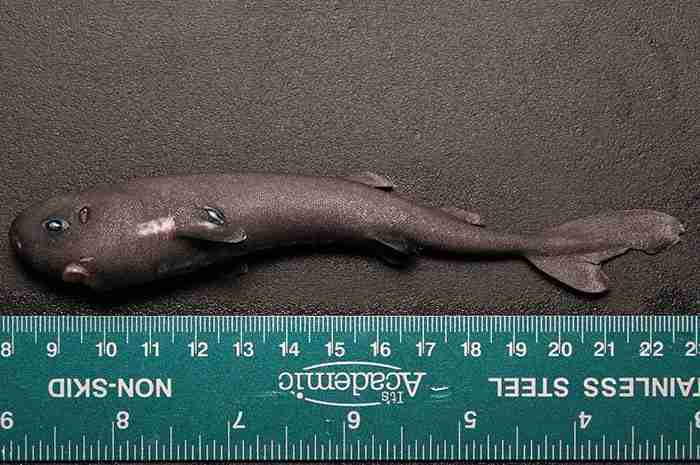
Scientists have identified a tiny new shark species from a 2010 Gulf of Mexico NOAA cruise: Mollisquama mississippiensis, the American pocket shark, a 14-centimeter newborn whose rare bioluminescent pockets reveal deep-sea mysteries and highlight museum collections.
Key takeaways
- New species discovered: A single 14-centimeter specimen has been identified as Mollisquama mississippiensis, the American pocket shark, based on detailed study of a specimen collected in 2010.
- Extremely rare group: Pocket sharks are known from only two species worldwide — the new American species and the Pacific Mollisquama parini.
- Unique bioluminescent pockets: The shark bears paired “pockets” near the gills that can secrete bioluminescent fluid and clusters of photophores.
- Modern methods unlocked the find: Microscopy, x-rays, CT scans and synchrotron imaging revealed internal anatomy and photophore patterns that distinguish this species.
- Research implications: The discovery highlights the value of museum collections, long-term specimen storage, and continued deep-ocean surveys.
Main content
Discovery and identification
Where and when: The specimen was collected during a 2010 NOAA research cruise in the northern Gulf of Mexico off Louisiana while scientists were mapping deep-water life and studying sperm whales. The tiny animal — a recently born male measuring about 14 centimeters — was brought ashore and became part of Tulane University’s specimen collection.
After careful re-examination years later, researchers concluded the specimen did not match known sharks and formally identified it as a new species, Mollisquama mississippiensis. The species name mississippiensis references the Mississippi River basin that drains into the Gulf, placing the discovery in regional context.
Taxonomy and rarity
Family: Mollisquama mississippiensis belongs to Dalatiidae, a family that includes other small deep-sea sharks such as cookiecutter and kitefin sharks. Pocket sharks are exceptionally rare in scientific records — before this identification only one other pocket shark, Mollisquama parini, had been described (1979, eastern Pacific), making the American pocket shark one of just two known pocket shark species.
“Because so few individuals have been recorded, each specimen carries outsized scientific value.”
Physical features and bioluminescence
The American pocket shark differs from large, familiar sharks in appearance: it has a bulbous head, gray body, darker fins, and cream-colored patches around the gills. Its most distinctive trait is a pair of small pockets behind the pectoral fins that can secrete a bioluminescent fluid. The skin also shows clusters of photophores — light-producing organs common in deep-sea animals.
Function unknown: Scientists speculate the secreted glow might attract prey, distract predators, or provide camouflage by matching faint ambient light. With only a single newborn specimen available, researchers emphasize caution in drawing firm behavioral conclusions.
Research methods and imaging
To study the tiny shark without damaging the specimen, researchers used a suite of modern imaging techniques: microscopy, x-ray imaging and high-resolution computed tomography (CT). Advanced imaging at the European Synchrotron Radiation Facility allowed visualization of internal bones, vertebral structure and photophore patterns at very high resolution — key traits that helped distinguish M. mississippiensis from its Pacific relative.
Comparison with the Pacific pocket shark
The Pacific pocket shark, Mollisquama parini, was described from a single specimen recovered in 1979. The American pocket shark appears smaller and shows anatomical differences in vertebrae, photophore arrangements and the configuration of its luminous pockets. Because both species are known from very few specimens, these comparisons are preliminary but informative for understanding pocket shark diversity and evolution.
Why this discovery matters
Deep-sea unknowns: The find underscores how much remains undocumented in the ocean; each new species helps fill gaps in biodiversity knowledge. Pocket sharks are so rare that each specimen provides unusually valuable insight into the evolution of bioluminescence and other deep-sea adaptations.
The discovery also highlights the power of long-term scientific partnerships and museum collections: specimens collected years earlier can yield new science when re-examined with modern tools.
Limitations and open questions
- Single specimen: Only one newborn individual is known, leaving adult size range, depth distribution, diet and reproductive behavior unknown.
- Bioluminescent function: How pocket secretions are used in the wild — whether for attraction, defense, or concealment — remains speculative.
- Need for more sampling: Future targeted surveys and luck will be required to find additional specimens or observe live animals.
Implications for San Luis Obispo, California
Local science and education: The discovery offers local institutions such as universities and aquaria in San Luis Obispo opportunities to engage students and the public in deep-sea science and biodiversity curriculum.
Fisheries and management: Although found far from California waters, the new species underscores links across deep-ocean ecosystems and may support arguments for broader survey funding and deeper protections.
Conservation awareness: Stories like the American pocket shark can raise local interest in ocean health and in reducing pollution and stressors that affect marine life across vast distances.
Collaboration opportunities: The Tulane–NOAA partnership that identified this species illustrates how collaborations can convert a single specimen into important science; local labs could seek partnerships for surveys, data analysis and outreach.
Further reading and sources
- Tulane University news release on the new pocket shark species
- Wikipedia entry on Mollisquama mississippiensis
- IFLScience article on pocket sharks and their rarity
- The Archaeologist blog on bioluminescence and the pocket shark
Note: The specimen was collected during a 2010 NOAA cruise and later examined at Tulane University; modern imaging and museum curation enabled the species description. For source material and detailed methods see the Tulane news release and linked articles above.