Trump administration withholds $40M from California over trucker English proficiency failings
The Trump administration has frozen $40,685,225 in federal truck-safety funds to California, alleging the state failed to enforce English Language Proficiency (ELP) rules for commercial drivers — a move tied to an FMCSA review and a fatal crash cited by the U.S. Department of Transportation.
Key takeaways
- Amount withheld: $40,685,225 from the Motor Carrier Safety Assistance Program (MCSAP) to California.
- Basis: A federal review concluded California rarely issued ELP out-of-service citations despite thousands of inspections.
- Trigger: Officials linked the enforcement gap to a fatal crash involving a driver who reportedly failed an English test.
- To restore funds: California must align policies with federal ELP standards, conduct ELP assessments on the roadside and place noncompliant drivers out of service.
Federal action and official statements
Transportation Secretary Sean P. Duffy announced the suspension of MCSAP funds as a public-safety measure tied to federal trucking rules. Duffy said California is “the only state in the nation that refuses to ensure big rig drivers can read our road signs and communicate with law enforcement,” calling the matter a fundamental safety concern. See the announcement from the U.S. Department of Transportation.
“The only state in the nation that refuses to ensure big rig drivers can read our road signs and communicate with law enforcement.” — Transportation Secretary Sean P. Duffy
Inspection findings and the ELP problem
A Federal Motor Carrier Safety Administration (FMCSA) review examined thousands of roadside inspections and found very few recorded ELP enforcement actions by California officers during a key period. Investigators highlight a gap between federal law — which requires drivers to read English road signs and communicate with law enforcement — and how California applied that law in practice.
Key inspection details: Between June 25 and Aug. 21, 2025, roughly 34,000 inspections with at least one violation in California produced just one ELP out-of-service citation. At least 23 drivers who had been put out of service for ELP violations in other states were inspected again in California without further action. These findings were documented in reporting and fed into the federal case against the state (CDL Life reporting; Bloomberg Government).
Link to a fatal crash
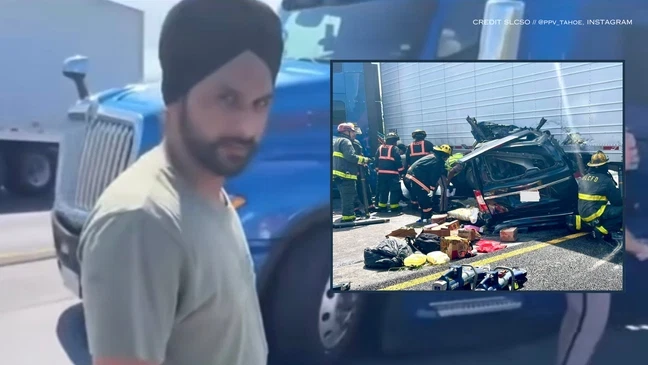
Federal officials tied the enforcement failure to a fatal crash that helped trigger the review. Authorities say the crash involved an undocumented driver who had reportedly failed the required English test but nonetheless obtained a commercial driver’s license in California. Public accounts provide limited detail; the administration presents the case as an example of risk from weak ELP enforcement (CDL Life reporting).
Policy background: what changed in 2025
In June 2025, President Trump signed an executive order reversing a 2016 policy that had discouraged placing drivers out of service for ELP violations. The order restored ELP failures to the list of out-of-service violations, elevating enforcement as a federal priority. The DOT review and the funding suspension followed that policy change (CDL Life reporting).
California’s response and political friction
As of reporting, there was no comprehensive public statement from state officials responding to the funding action. Secretary Duffy singled out Governor Gavin Newsom, accusing state leadership of “obstructing federal law,” signaling a likely escalation in state-federal tensions over enforcement and immigration-related policy. Coverage framed the move as a national safety issue rather than solely a state policy choice (Bloomberg Government).
What California must do to restore funding
The DOT outlined conditions for restoring MCSAP funds. California must:
- Adopt laws or regulations aligning with federal ELP standards;
- Ensure state inspectors conduct ELP assessments during routine roadside inspections;
- Place drivers who fail ELP assessments out of service per federal rules.
The federal notice ties funding to compliance processes rather than to a specific citation count, but enforcement actions must be routine and visible enough to satisfy FMCSA auditors.
Legal and practical questions
Observers note several unresolved issues: Will California amend state law or simply instruct local enforcement to follow federal ELP standards? Might the state challenge the withholding in court on grounds the federal interpretation overreaches? The administration framed the move as tied to highway safety and program rules, which could complicate a legal challenge.
Industry and safety groups face trade-offs. Enhanced ELP enforcement may reduce some highway risks, officials argue, but could also temporarily remove drivers from service and strain freight capacity unless carriers increase testing and training.
Implications for San Luis Obispo, California
Economic impact
Local road safety and enforcement programs often rely on state and federal funding. A loss of MCSAP dollars could reduce roadside inspections, delay equipment purchases and limit safety audits for regional highway patrol units serving San Luis Obispo County. Trucking firms using U.S. 101 corridors may face operational strain if more drivers are placed out of service without trained replacements, potentially increasing costs for growers, distributors and retailers.
Political consequences
The dispute underscores state-federal tension that resonates locally. County and city officials may be asked to press the state for a plan to restore funding or to weigh in on enforcement changes. Local leaders who depend on federal safety grants could face pressure from both residents and industry stakeholders.
Social effects
Residents might see more visible enforcement if California adopts stricter ELP checks, including additional inspections at rest stops and freeway pullouts. While some communities will welcome stronger highway-safety measures, others concerned about immigrant workers’ rights may highlight potential civil-rights implications.
Cultural relevance
The issue intersects with language access, immigration and public-safety values on the Central Coast. Debates over increased ELP enforcement will reflect local priorities about labor, inclusion and roadway safety.
Practical applications for residents
- Trucking companies and drivers should review English-proficiency training and testing policies to remain compliant.
- Local law enforcement and public-works agencies should assess how MCSAP funding changes could affect roadside safety programs and prepare contingency plans.
- Businesses relying on truck freight should monitor enforcement changes and plan for potential short-term capacity impacts.